Radiation is a mode of energy transfer that requires no matter in order to propagate. This is how the Sun heats the Earth across the vacuum of space, how we feel the warmth of a fireplace from a distance, and how our body exchanges energy with the walls of a room even when the air is still. Up to now, we have spoken of heat without ever specifying how it is transferred: by conduction, by convection, or by radiation. This final lesson is devoted to radiation.
We will first see that radiation enclosed in a cavity at equilibrium is itself a thermodynamic system, to which all the tools we have built apply. This “photon gas” is a remarkable system: without any assumption about its microscopic nature, thermodynamics shows that its energy grows as the fourth power of temperature. From this we will derive the Stefan-Boltzmann law, and then use it to write energy balances, from the human body to the planet Earth, including the greenhouse effect and satellites.
1. Thermal radiation
1.1. Every warm body radiates
At any nonzero temperature, all matter emits electromagnetic radiation, called thermal radiation. Its origin is microscopic: the electric charges of matter, electrons and nuclei, undergo thermal agitation, and every accelerated charge radiates. An object at room temperature emits mostly in the infrared, a range invisible to the eye but detectable with a thermal camera. When a piece of metal is heated, part of its emission reaches the visible range: it glows red, then turns yellow and almost white at very high temperature. The filament of an old incandescent light bulb, at about K, is an example. Conversely, matter absorbs part of the radiation it receives.
1.2. Equilibrium radiation and the blackbody
Consider a closed cavity, empty of matter, whose walls are held at temperature . The walls emit radiation inward and absorb the radiation that strikes them. After some time, an equilibrium state is reached in which the cavity is filled with steady radiation in thermal equilibrium with the walls: this is equilibrium radiation, or blackbody radiation.
The second law makes it possible to establish a fundamental property of this radiation: its energy density , that is, the energy per unit volume, depends only on temperature, and not on the material of the walls or on the shape of the cavity. Suppose indeed that two cavities at the same temperature , made of different materials, contain radiation with different energy densities. Let us connect them with a small tube. Radiation from the “richer” cavity would pass into the other more than the reverse, and would transfer energy from the first to the second. One could then run an engine between these two cavities initially at the same temperature, which is forbidden by the Kelvin-Planck statement of the second law. This argument, due to Kirchhoff in 1860, shows that
Equilibrium radiation is therefore universal: this is what is called blackbody radiation. The name comes from the fact that a small opening made in the wall of the cavity lets exactly this radiation escape, and behaves as a perfectly absorbing body: a ray entering it undergoes many reflections inside and has practically no chance of coming back out. Such a hole looks perfectly black at room temperature.
2. The photon gas
2.1. Radiation pressure
The radiation contained in the cavity is not merely energy: it also exerts a pressure on the walls, called radiation pressure. Electromagnetism, or equivalently the description of radiation as a gas of photons moving at the speed of light in all directions, shows that this pressure is
for isotropic radiation. We will take this result for granted; it plays the role of an equation of state. It is instructive to compare it with that of the monatomic ideal gas, for which , that is, : the factor is different because photons have a fixed speed and an energy proportional to their momentum, instead of a kinetic energy .
The radiation in the cavity is therefore a simple thermodynamic system, with volume , internal energy and pressure . We have two equations of state, exactly as for the ideal gas in Lesson 7. Let us see what thermodynamics can deduce from them.
2.2. The Stefan-Boltzmann law
In Lesson 9, we derived, from the fundamental relation alone, the expression for the variation of internal energy with volume at constant temperature:
For radiation, gives , and gives . The relation becomes
This differential equation integrates immediately, giving
where is a constant. This is the Stefan-Boltzmann law. Stefan had discovered it experimentally in 1879, and in 1884 Boltzmann gave the thermodynamic derivation we have just reproduced. The result is striking: thermodynamics, armed only with the fundamental relation and the equation of state , completely determines the temperature dependence of the energy of radiation.
As with the Sackur-Tetrode formula, however, thermodynamics cannot fix the value of the constant . Its calculation had to wait for Planck, in 1900, and the birth of quantum physics: . This value is very small: at room temperature, the energy density of radiation is barely , and its pressure a few micropascals. But the growth is so rapid that, in the cores of the most massive stars, radiation pressure becomes comparable to that of matter.
2.3. Entropy and chemical potential of radiation
We can now calculate the entropy of radiation. The fundamental relation at variable volume gives
With , we have , and . It follows that
hence
The integration constant is zero, since entropy must be extensive, that is, proportional to . Note that tends to zero with temperature, in agreement with the third law.
Finally, let us calculate the Gibbs free energy of radiation:
According to Lesson 10, for an extensive system: the chemical potential of photons is therefore zero. This result has a simple interpretation. The number of photons in the cavity is not conserved: the walls constantly emit and absorb them. At equilibrium, the number of photons therefore adjusts freely, like an internal variable, so as to minimize the Helmholtz free energy at fixed and . The minimum condition, , is precisely the vanishing of the chemical potential.
3. From equilibrium radiation to emitted radiation
3.1. The power emitted by a blackbody
What power escapes through a small opening made in the wall of a cavity? Photons travel at speed in all directions; only those heading toward the opening get out, and the more oblique their direction, the less efficiently they do so. A geometric calculation, which we will take for granted, shows that the power emitted per unit area of the opening, called the radiant exitance, is . Combined with the Stefan-Boltzmann law, this gives
where is the Stefan-Boltzmann constant. This is the form in which the law is most often used. A blackbody, that is, a body that absorbs all the radiation it receives, emits exactly this power per unit area.
A real body emits less than a blackbody at the same temperature. To a first approximation, it is described by an emissivity , between and :
Human skin, water and most paints have an emissivity close to in the infrared, whereas a polished metal has a very low emissivity. The second law also imposes Kirchhoff's law: at a given wavelength, a good absorber is also a good emitter, and the emissivity of a body equals its absorptivity. Otherwise, a body placed in a cavity at its own temperature would absorb more than it emits, or the reverse, and would spontaneously heat up or cool down, in contradiction with the second law.
3.2. The blackbody spectrum
The energy of radiation is distributed over all wavelengths, according to a law established by Planck in 1900. We will need only two of its consequences. The first is the law, which we have derived. The second is Wien's displacement law, which gives the wavelength at which emission is most intense:
The hotter a body, the more its emission shifts toward short wavelengths. The Sun, whose surface is at about K, emits mainly around , in the visible range, which is obviously no coincidence: our eyes have adapted to the available light. A body at room temperature, around K, emits mostly around , in the thermal infrared. This separation between solar radiation and terrestrial radiation underlies the greenhouse effect, as we will see.
4. Radiative exchange and equilibrium
4.1. Net radiative flux
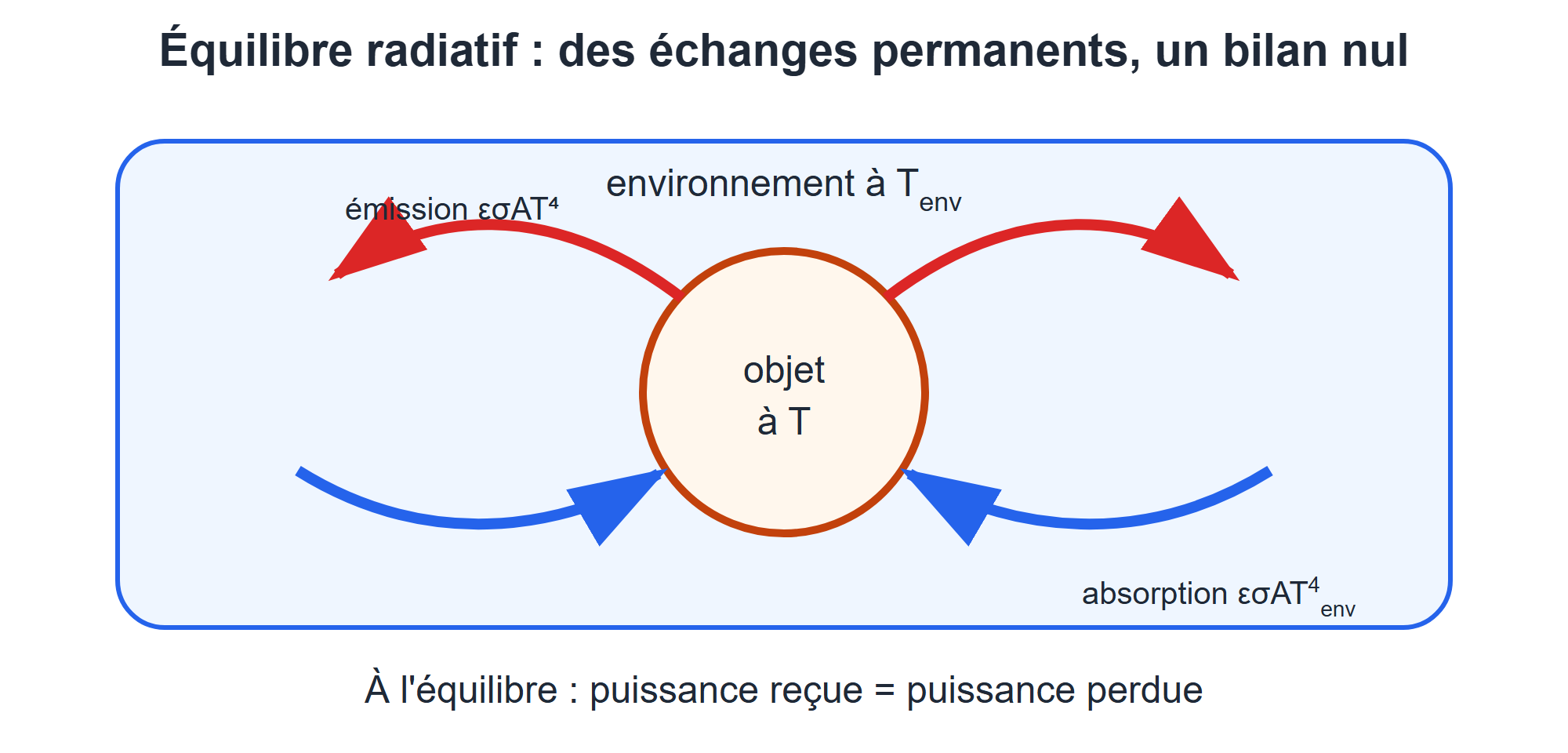
An object at temperature , with surface area and emissivity , placed in a large enclosure whose walls are at temperature , emits and receives radiation at the same time. It emits the power . It receives the radiation of the enclosure, which is equilibrium radiation at , and absorbs the fraction of it, according to Kirchhoff's law. The net power it loses by radiation is therefore
This expression gives the direction of the exchange, in agreement with the second law: if , the object loses energy; if , it gains energy. If , the net flux is zero, even though the object and the walls keep emitting and absorbing radiation. Radiative equilibrium is a dynamic equilibrium: the exchanges do not stop, they balance exactly (figure 1).
4.2. Radiation from the human body
Our body constantly radiates in the infrared, which thermal cameras make visible (figure 2). The detector measures an infrared flux within a certain wavelength band, and software converts it into an apparent temperature, displayed in false colors. This conversion assumes a given emissivity: a shiny metallic surface, which emits little and reflects a lot, can thus send back the radiation of a nearby object and completely distort the measurement.
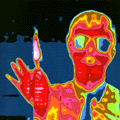
Figure taken from https://heasarc.gsfc.nasa.gov/docs/xte/learning_center/universe/infrared.html
The image is reproduced from NASA [3], in accordance with its reuse guidelines [4].
Let us estimate the power radiated by an unclothed person with surface area , whose skin is at , that is, K, with an emissivity close to . The emitted power is
This is enormous, far more than the W we produce on average (Lesson 9)! But in a room whose walls are at , we also receive radiation from the walls, and it is the net balance that matters. To avoid computing the difference between two large, nearly equal numbers, let us factor exactly:
When the temperature difference is small compared with the mean temperature , this expression is approximately , and the net flux becomes proportional to the temperature difference:
With K, we find , and a net flux of about W. Part of the body surface, between the arms and the torso for example, radiates toward itself, which reduces this value somewhat. Radiation is therefore one of the main modes of heat loss for the human body, together with convection, evaporation of sweat and respiration. This is why we feel cold in a room with cold walls, even when the air is at a comfortable temperature.
5. The radiative equilibrium of the Earth
5.1. The model without an atmosphere
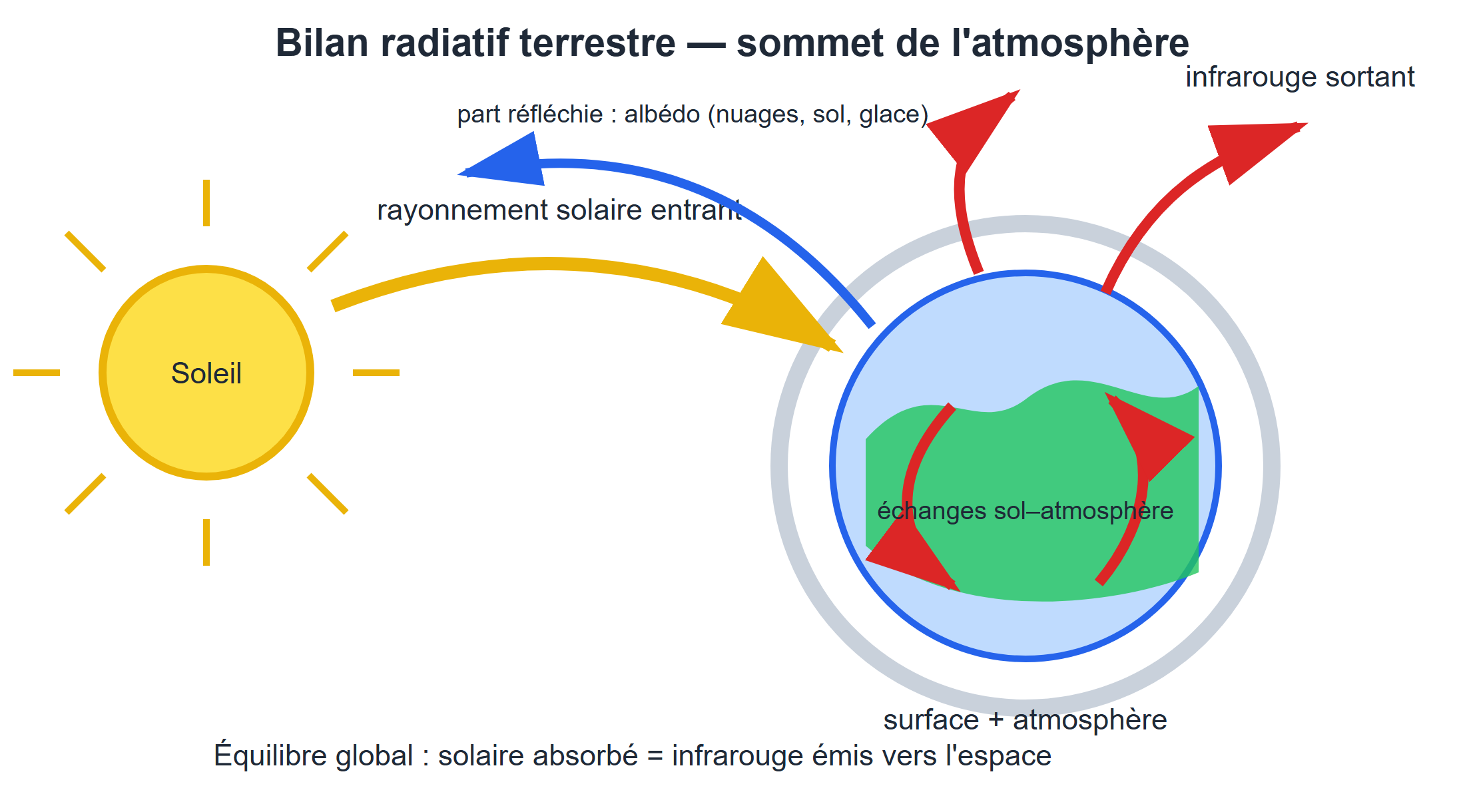
The Earth receives its energy from the Sun by radiation, and can lose it only by radiation, to space. Its mean temperature therefore results from a radiative equilibrium. Let denote the solar power received, at the Earth's distance, by a surface perpendicular to the rays. The Earth intercepts solar radiation over a disk of area , its shadow. It directly reflects a fraction of it, called the albedo, mainly from clouds, ice and deserts. The absorbed power is therefore
The Earth, on the other hand, emits over its entire surface , since rotation distributes heat between day and night. In the simplest model, it emits as a blackbody of uniform temperature :
At equilibrium, , and the Earth's radius cancels out:
Numerically, we find K, that is, . This is well below the observed mean surface temperature of the globe, about K, or [1]. Has the model failed? Not quite: is the temperature at which the Earth radiates to space, as it would be seen from a satellite. The K difference from the ground temperature is due to the atmosphere.
5.2. The greenhouse effect
The atmosphere is nearly transparent to solar radiation, which lies mainly in the visible. It is, however, largely opaque to the infrared radiation emitted by the ground, which is absorbed by water vapor, carbon dioxide, methane and clouds. Heated by this radiation, the atmosphere in turn radiates, to space but also toward the ground. The ground therefore receives both solar radiation and infrared radiation from the atmosphere, and its equilibrium temperature is higher than : this is the natural greenhouse effect, without which the Earth would be frozen.
It can be understood in another way. The radiation escaping to space is emitted, on average, not by the ground but by layers of the atmosphere a few kilometers up, where it becomes thin enough to let the radiation through. It is to these layers that the temperature K corresponds. Now, the temperature of the atmosphere decreases with altitude, by about K per kilometer; the ground, which lies lower, is therefore warmer.
If the concentration of carbon dioxide increases, the atmosphere becomes more opaque in certain infrared bands, and radiation to space is emitted from higher, and therefore colder, layers. At unchanged temperature, the Earth would then emit less than it absorbs: its budget becomes positive, and it accumulates energy, overwhelmingly in the oceans, as we saw in Lesson 9. The surface and the lower atmosphere warm up until emission to space once again balances the absorbed solar power [1].
Clouds have two opposite effects. They reflect part of the solar radiation, which tends to cool the planet; but they also absorb terrestrial infrared radiation and re-emit it from their colder tops, which tends to warm it. Low, thick clouds mainly have a cooling effect, whereas high, cold clouds tend to have a warming effect [2]. The net balance depends on the type of cloud, and remains one of the main uncertainties in climate models.
Finally, climate equilibrium is never strictly reached. The oceans store energy, evaporation and convection transport it, and currents redistribute it between the equator and the poles. The equality between the power received and the power emitted holds only on average over the whole planet and over sufficiently long periods.
6. Cooling a satellite
In the vacuum of space, there is neither conduction nor convection to the outside: a satellite can get rid of the heat produced by its electronics only by radiation. One might think that the cold of space makes this easy. It does not: it is the radiation emitted by the satellite itself that limits heat rejection, and large radiators are needed to achieve it.
Consider an orbital data center that dissipates a power and rejects it through radiators of total area , at temperature . The sky background is below K, and the radiation it sends back is negligible. If the radiators see neither the Sun nor the Earth, equilibrium requires
For a power of one megawatt, an emissivity of and radiators at K, a temperature imposed by the electronics, we find a radiating area of about , or three handball courts. The strong dependence shows the benefit of operating the radiators as hot as possible: at K, the area would be three times smaller.
European studies have examined the feasibility of such orbital data centers, powered by solar energy [5]. Electrical energy is abundant there, but cooling requires very large radiating surfaces, in addition to constraints of mass, launch, maintenance and communication.
7. Summary
Equilibrium radiation is a thermodynamic system in its own right. With the single equation of state , the fundamental relation requires that its energy grow as , that its entropy be , and that the chemical potential of photons be zero. The resulting Stefan-Boltzmann law, supplemented by the emissivity and Kirchhoff's law, makes it possible to write the radiative budget of any body.
8. References
- NASA Earth Observatory, Climate and Earth's Energy Budget.
- NASA Earth Observatory, Clouds and Radiation.
- NASA Goddard Space Flight Center, What If We Could See Infrared Light?
- NASA, Images and Media Usage Guidelines.
- European Commission, ASCEND: Advanced Space Cloud for European Net zero emissions and Data sovereignty.