Solved thermodynamics exercise
Two gases separated by an internal partition
Exercise 22 · Lesson 6 — The Second Law of Thermodynamics
- second law
- maximum entropy
- isolated system
- diathermal partition
- movable partition
- thermal equilibrium
- mechanical equilibrium
Statement
A rigid vessel isolated from its surroundings contains two monatomic ideal gases separated by an internal partition that is initially fixed, impermeable and adiabatic. Compartment 1 contains moles at temperature ; compartment 2 contains moles at temperature . Both compartments initially have the same volume . The partition's energy and heat capacity are negligible; when released, it moves without friction or any additional force. The experiments in questions 3 and 5 each start from the initial state. Define .
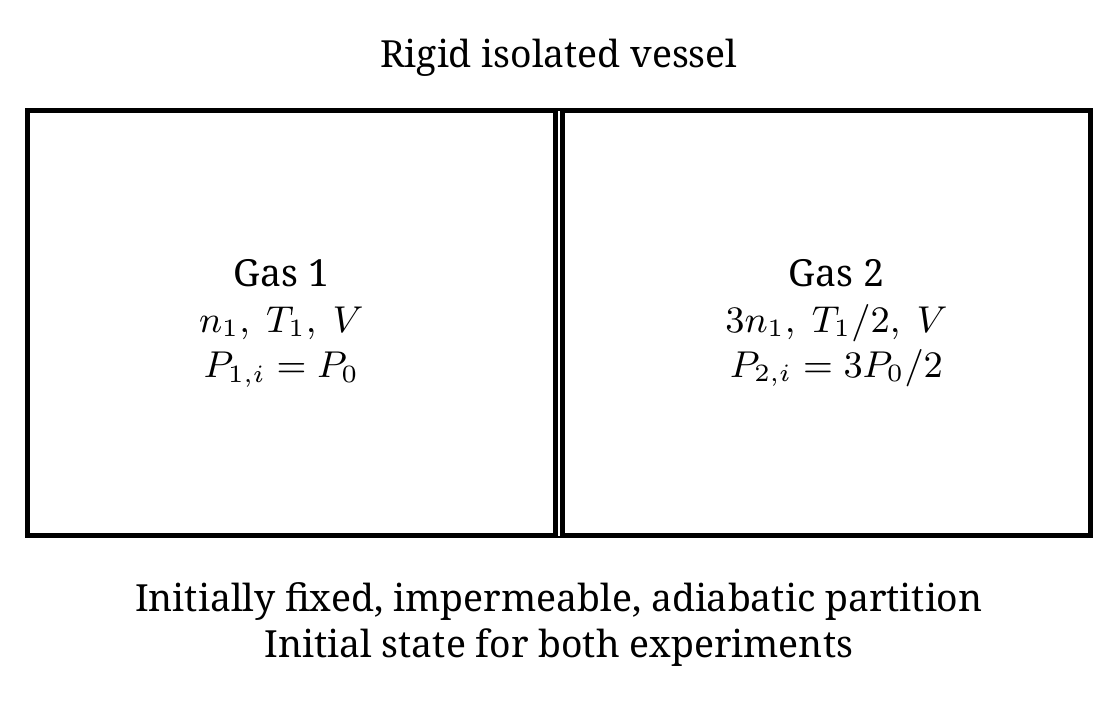
- Sketch the vessel. Label the gases, the internal partition, the amounts of substance, and the initial temperatures, volumes and pressures. While the partition remains fixed, impermeable and adiabatic, is a temperature or pressure difference enough to cause a change?
- Express both initial pressures algebraically in terms of .
- The partition becomes diathermal but remains fixed and impermeable. Use the first and second laws to justify the thermal-equilibrium condition, then determine the final temperature and pressures.
- Calculate the energy exchanged between the gases and identify its form. Establish the entropy balance for the combined system and verify that the entropy produced is positive.
- In a second experiment, the partition becomes diathermal and movable. Examine the stationarity of the isolated system's entropy to justify the thermal- and mechanical-equilibrium conditions. Determine the final temperature, pressure and volumes, then establish the entropy balance. Compare with the fixed-partition case.
Hint
Detailed solution
Question 1. The diagram shows a rigid vessel of total volume divided by a partition. On the left: ; on the right: . The outer walls are adiabatic. With a fixed, impermeable, adiabatic internal partition, no exchange is allowed: each gas retains its state even if the temperatures and pressures differ. The partition's support sustains the pressure difference. Question 3 — Fixed diathermal partition. During a small energy transfer with , the volumes remain constant: for each gas, . Adding gives The temperatures in this variation refer to the state being considered. Factoring gives At equilibrium, entropy is maximal; the coefficient of must therefore vanish, requiring . Conservation of energy gives Dividing the energy balance by gives Then and , so Because the partition is fixed, mechanical equilibrium between the gases is not required: their final pressures may differ. Gas 1 receives the opposite heat: , whereas . The partition is fixed, so . The combined system is isolated, so and . Since the volumes are constant, Gas 1 loses entropy and gas 2 gains it. Their sum is This entropy production reflects spontaneous heat transfer between gases initially at different temperatures. To verify the sign without numerical values, combine the logarithms: Question 5 — Movable diathermal partition. With and , The partition independently allows energy and volume to be redistributed. Stationarity must therefore hold for every and every : both coefficients vanish. The first requires ; the second then gives , or . Conservation of energy again gives . At common pressure and temperature, volumes are proportional to amounts of substance. Since their sum is , Thus and . The internal-energy changes are the same as for the fixed partition, but energy is now exchanged as both heat and work. The entropy balance contains the same temperature terms as in question 4, with additional volume terms: Adding gives The increase compared with the fixed-partition case is Allowing the partition to move therefore increases the final entropy accessible to the system.