Solved thermodynamics exercise

Adiabatic piston: mechanical equilibrium without thermal equilibrium

Exercise 23 · Lesson 6 — The Second Law of Thermodynamics

  • movable piston
  • adiabatic partition
  • electrical resistor
  • mechanical equilibrium
  • entropy produced

Statement

A rigid, thermally insulated horizontal cylinder is divided into two compartments by an impermeable, adiabatic, frictionless movable piston with negligible energy. Each compartment contains nn moles of ideal gas with constant molar heat capacity cV=R/(γ−1)c_V=R/(\gamma-1), where γ=cP/cV>1\gamma=c_P/c_V>1, initially at (P0,V0,T0)(P_0,V_0,T_0). A resistor in compartment 1 is powered from outside. Heating is slow enough to maintain mechanical equilibrium and make the compression of gas 2 reversible, until Pf=xP0P_f=xP_0, x>1x>1. The current is then switched off. Neglect the resistor's heat capacity.

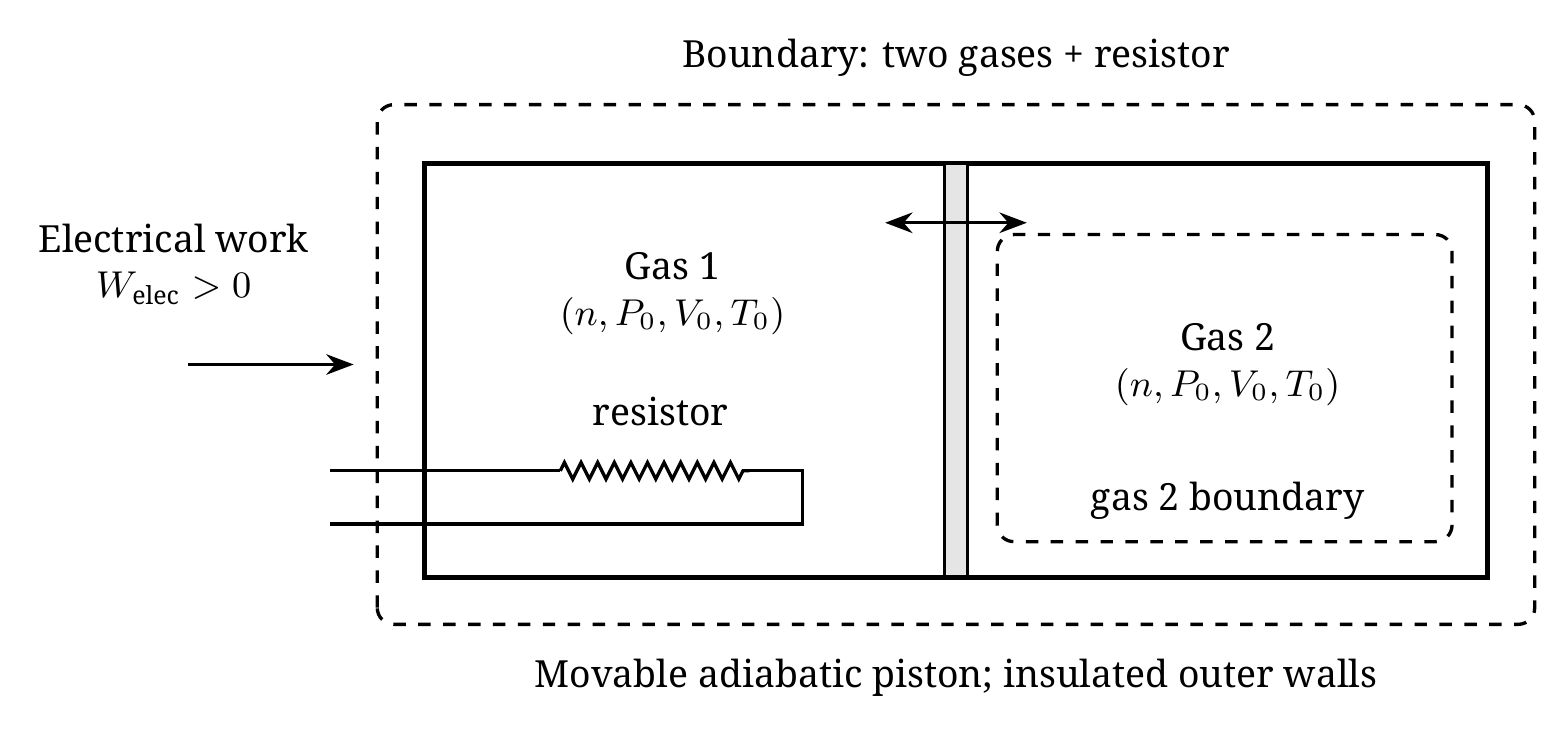
  1. Draw the boundaries of the systems “gas 2” and “two gases + resistor”. What form of energy crosses the boundary of the second system?
  2. Determine V2,fV_{2,f}, T2,fT_{2,f}, then V1,fV_{1,f} and T1,fT_{1,f}. Does the adiabatic partition require T1,f=T2,fT_{1,f}=T_{2,f}?
  3. Calculate the energy changes of both gases and the electrical work received WelecW_{\mathrm{elec}}.
  4. Calculate ΔS1\Delta S_1, ΔS2\Delta S_2 and the entropy produced in “two gases + resistor”. Why does slow heating not make the entire experiment reversible?
  5. After the current is switched off, the piston is made diathermal while remaining movable. Determine the new equilibrium and the additional entropy produced.

Hint

Hint
Apply the adiabatic relation to gas 2 only. The total volume is 2V02V_0. For the system including the resistor, Qext=0Q_{\mathrm{ext}}=0 and energy enters as electrical work. Use the ideal-gas entropy formula.

Detailed solution

Solution

Figure
Figure 1

Question 1. The diagram shows the resistor in compartment 1, the insulated piston and electrical wires crossing the outer boundary. Gas 2 receives mechanical work through the piston and no heat. For “two gases + resistor”, no external heat is exchanged and the outer walls are rigid: only electrical work enters. Work exchanged across the piston is internal to this combined system.

Question 2. Gas 2 undergoes reversible adiabatic compression, so P0V0γ=PfV2,fγP_0V_0^\gamma=P_fV_{2,f}^\gamma. With Pf=xP0P_f=xP_0,

(V2,fV0)γ=1x,V2,f=x−1/γV0.\left(\frac{V_{2,f}}{V_0}\right)^\gamma=\frac1x, \qquad V_{2,f}=x^{-1/\gamma}V_0.

Set a=x−1/γa=x^{-1/\gamma}. The equation of state at the initial and final states gives

T2,fT0=PfV2,fP0V0=xa,T2,f=xaT0.\frac{T_{2,f}}{T_0}=\frac{P_fV_{2,f}}{P_0V_0}=xa, \qquad T_{2,f}=xaT_0.

The total volume is 2V02V_0 and the piston imposes the same pressure in compartments 1 and 2:

V1,f=2V0−V2,f=(2−a)V0,T1,f=T0PfV1,fP0V0=x(2−a)T0.V_{1,f}=2V_0-V_{2,f}=(2-a)V_0, \qquad T_{1,f}=T_0\frac{P_fV_{1,f}}{P_0V_0}=x(2-a)T_0.

Since x>1x>1 and γ>1\gamma>1, 0<a<10<a<1, hence 2−a>a2-a>a and T1,f>T2,fT_{1,f}>T_{2,f}. The partition allows work but no direct heat transfer. After the current is switched off, this state is a mechanical equilibrium subject to the adiabatic constraint in the adopted macroscopic model.

Question 3. For each gas, ΔU=ncV(Tf−T0)\Delta U=nc_V(T_f-T_0) and ncVT0=nRT0/(γ−1)=P0V0/(γ−1)nc_VT_0=nRT_0/(\gamma-1)=P_0V_0/(\gamma-1). Substituting the calculated temperatures gives

ΔU1=P0V0γ−1[x(2−a)−1],ΔU2=P0V0γ−1(xa−1).\Delta U_1=\frac{P_0V_0}{\gamma-1}[x(2-a)-1],\qquad \Delta U_2=\frac{P_0V_0}{\gamma-1}(xa-1).

The energy stored in the resistor is negligible. The first law applied to the combined system therefore gives

Welec=ΔU1+ΔU2=P0V0γ−1[x(2−a)−1+xa−1]=P0V0γ−1(2x−2)=2P0V0γ−1(x−1).\begin{aligned} W_{\mathrm{elec}}&=\Delta U_1+\Delta U_2\\ &=\frac{P_0V_0}{\gamma-1}[x(2-a)-1+xa-1]\\ &=\frac{P_0V_0}{\gamma-1}(2x-2) =\frac{2P_0V_0}{\gamma-1}(x-1). \end{aligned}

For gas 2, Q2=0Q_2=0, so the work done by the piston is W2=ΔU2W_2=\Delta U_2. Since the piston stores no energy, its work on gas 1 is −W2-W_2. These two work contributions cancel in the combined system's balance.

Question 4. For gas 2, the entropy formula gives

ΔS2=ncVln⁡(xa)+nRln⁡a=ncV[ln⁡x+ln⁡a+(γ−1)ln⁡a]=ncVln⁡(xaγ)=0,\begin{aligned} \Delta S_2&=nc_V\ln(xa)+nR\ln a\\ &=nc_V[\ln x+\ln a+(\gamma-1)\ln a]\\ &=nc_V\ln(xa^\gamma)=0, \end{aligned}

because aγ=1/xa^\gamma=1/x. This recovers the isentropic nature of reversible compression. For gas 1,

ΔS1=ncVln⁡[x(2−a)]+nRln⁡(2−a)=ncV[ln⁡x+γln⁡(2−a)]=ncVln⁡[x(2−a)γ].\begin{aligned} \Delta S_1&=nc_V\ln[x(2-a)]+nR\ln(2-a)\\ &=nc_V[\ln x+\gamma\ln(2-a)] =nc_V\ln[x(2-a)^\gamma]. \end{aligned}

We have x>1x>1 and 2−a>12-a>1, so the logarithm's argument exceeds 1: ΔS1>0\Delta S_1>0. The combined system receives no entropy from outside: electrical work carries none. Thus Si=ΔS1+ΔS2=ΔS1S_{\mathrm{i}}=\Delta S_1+\Delta S_2=\Delta S_1. Joule heating produces entropy even when heating is slow. The adiabatic relation therefore does not apply to gas 1.

Question 5. Once the current is switched off, the combined system is isolated. The now diathermal, movable partition allows final temperatures and pressures to become equal. Since both gases contain the same nn, P∗V1,∗=nRT∗=P∗V2,∗P_*V_{1,*}=nRT_*=P_*V_{2,*} gives V1,∗=V2,∗=V0V_{1,*}=V_{2,*}=V_0. Conservation of energy requires

ncV(T∗−T1,f)+ncV(T∗−T2,f)=0.nc_V(T_*-T_{1,f})+nc_V(T_*-T_{2,f})=0.

Dividing by ncVnc_V and substituting the temperatures gives

2T∗=T1,f+T2,f=xT0[(2−a)+a]=2xT0,2T_*=T_{1,f}+T_{2,f}=xT_0[(2-a)+a]=2xT_0,

hence T∗=xT0T_*=xT_0 and P∗=nRxT0/V0=xP0P_*=nRxT_0/V_0=xP_0. For the entropy changes during this new process,

ΔS1,add=ncVln⁡xT0x(2−a)T0+nRln⁡V0(2−a)V0=−ncPln⁡(2−a),ΔS2,add=ncVln⁡xT0xaT0+nRln⁡V0aV0=−ncPln⁡a.\begin{aligned} \Delta S_{1,\mathrm{add}} &=nc_V\ln\frac{xT_0}{x(2-a)T_0}+nR\ln\frac{V_0}{(2-a)V_0} =-nc_P\ln(2-a),\\ \Delta S_{2,\mathrm{add}} &=nc_V\ln\frac{xT_0}{xaT_0}+nR\ln\frac{V_0}{aV_0} =-nc_P\ln a. \end{aligned}

Their sum is the additional entropy produced, since the combined system is isolated:

Si,add=−ncP[ln⁡(2−a)+ln⁡a]=−ncPln⁡[a(2−a)].S_{\mathrm{i},\mathrm{add}}=-nc_P[\ln(2-a)+\ln a]=-nc_P\ln[a(2-a)].

For 0<a<10<a<1, 0<a(2−a)=1−(1−a)2<10<a(2-a)=1-(1-a)^2<1, so its logarithm is negative. The minus sign makes Si,add>0S_{\mathrm{i},\mathrm{add}}>0.