Solved thermodynamics exercise

Carnot cycle: energy and entropy along each branch

Exercise 21 · Lesson 6 — The Second Law of Thermodynamics

  • Carnot cycle
  • ideal gas
  • entropy balance
  • efficiency
  • entropy diagram

Statement

nn moles of ideal gas with constant heat-capacity ratio γ=cP/cV>1\gamma=c_P/c_V>1 undergo the reversible cycle A→B→C→D→AA\to B\to C\to D\to A: adiabatic compression ABAB from TCT_{\mathrm{C}} to TH>TCT_{\mathrm{H}}>T_{\mathrm{C}}, isothermal expansion BCBC at THT_{\mathrm{H}} from VBV_B to VC=rVBV_C=rV_B with r>1r>1, adiabatic expansion CDCD, then isothermal compression DADA at TCT_{\mathrm{C}}.

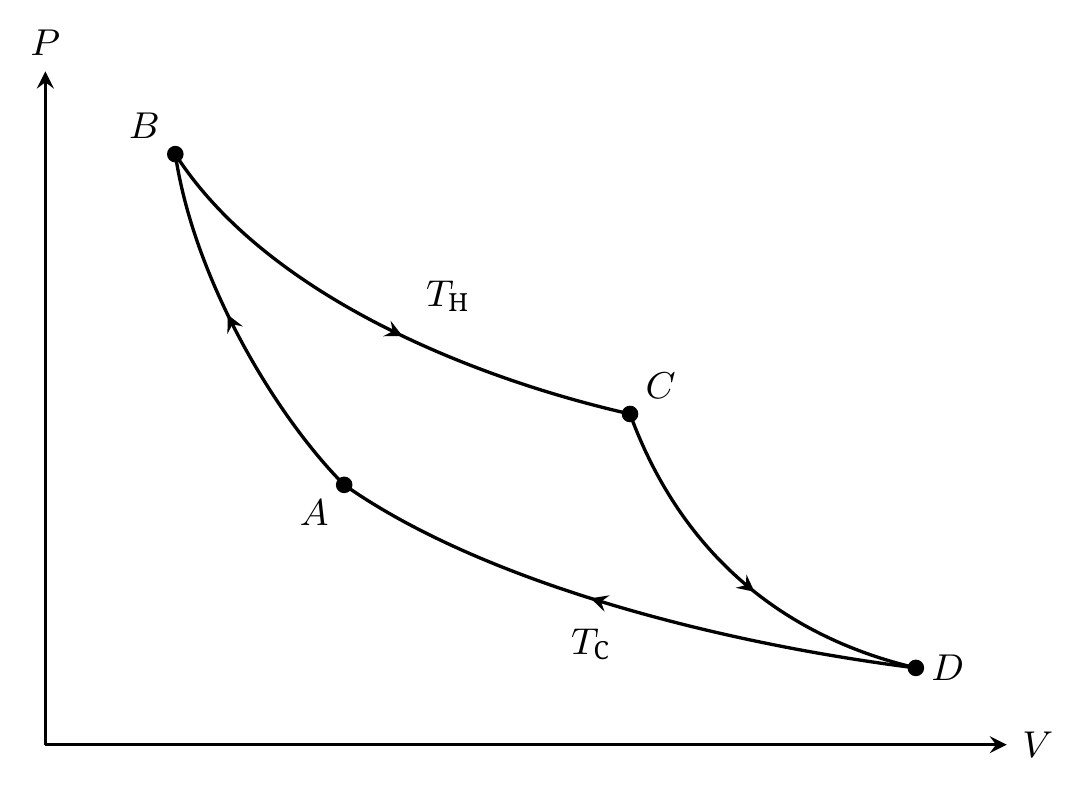
Carnot cycle traversed in the direction A B C D A. Qualitative diagram; the vertex labels are those used in the problem.
Figure 1. Carnot cycle traversed in the direction A→B→C→D→AA\to B\to C\to D\to A. Qualitative diagram; the vertex labels are those used in the problem.
  1. Identify the isotherms and adiabats on the (P,V)(P,V) diagram, then determine VAV_A and VDV_D in terms of VB,r,TH/TCV_B,r,T_{\mathrm{H}}/T_{\mathrm{C}} and γ\gamma.
  2. Calculate the heat received and the gas's entropy change along each branch. Draw the cycle in the (S,T)(S,T) diagram.
  3. Calculate the work received over a cycle, the efficiency and the entropy changes of both reservoirs. What entropy balance results?
  4. An irreversible engine receives the same heat QH>0Q_{\mathrm{H}}>0 from the hot reservoir at THT_{\mathrm{H}} and rejects heat to the same cold reservoir at TCT_{\mathrm{C}}. Express its efficiency in terms of SiS_{\mathrm{i}}, the entropy produced per cycle in the combined engine and reservoirs.
  5. Numerical application: n=1,0 moln=1{,}0\ \mathrm{mol}, TH=500 KT_{\mathrm{H}}=500\ \mathrm K, TC=300 KT_{\mathrm{C}}=300\ \mathrm K, r=3,4r=3{,}4 and R=8,314 J mol−1 K−1R=8{,}314\ \mathrm{J\,mol^{-1}\,K^{-1}}. The irreversible engine in the previous question produces Si=2,0 J K−1S_{\mathrm{i}}=2{,}0\ \mathrm{J\,K^{-1}} per cycle. Calculate the heat received QHQ_{\mathrm{H}}, the Carnot efficiency, the efficiency reduction caused by this entropy production (in percentage points), and the irreversible engine's efficiency.

Hint

Hint
Both adiabats satisfy TVγ−1=constTV^{\gamma-1}=\mathrm{const}. Along a reversible isotherm, Q=TΔSQ=T\Delta S.

Detailed solution

Solution
Question 1. The diagram shows adiabats ABAB and CDCD, BCBC on the hot isotherm and DADA on the cold isotherm. The cycle runs clockwise. Along adiabat ABAB, the adiabatic relation gives

TCVAγ−1=THVBγ−1,(VAVB)γ−1=THTC.T_{\mathrm{C}}V_A^{\gamma-1}=T_{\mathrm{H}}V_B^{\gamma-1},\qquad \left(\frac{V_A}{V_B}\right)^{\gamma-1}=\frac{T_{\mathrm{H}}}{T_{\mathrm{C}}}.

Raising to the power 1/(γ−1)1/(\gamma-1) and setting b=(TH/TC)1/(γ−1)b=(T_{\mathrm{H}}/T_{\mathrm{C}})^{1/(\gamma-1)} gives VA=bVBV_A=bV_B. Similarly, along CDCD,

THVCγ−1=TCVDγ−1⟹VD=bVC=brVB.T_{\mathrm{H}}V_C^{\gamma-1}=T_{\mathrm{C}}V_D^{\gamma-1} \quad\Longrightarrow\quad V_D=bV_C=brV_B.

Thus VD/VA=(brVB)/(bVB)=rV_D/V_A=(brV_B)/(bV_B)=r: the isotherms have the same volume ratio, traversed in opposite directions.

Question 2. Along each reversible adiabat, δQrev=0\delta Q_{\mathrm{rev}}=0 and dS=δQrev/T=0\mathrm dS=\delta Q_{\mathrm{rev}}/T=0:

QAB=QCD=0,ΔSAB=ΔSCD=0.Q_{AB}=Q_{CD}=0,\qquad \Delta S_{AB}=\Delta S_{CD}=0.

Along an ideal-gas isotherm, dU=0\mathrm dU=0, so δQrev=P dV=nRT dV/V\delta Q_{\mathrm{rev}}=P\,\mathrm dV=nRT\,\mathrm dV/V. For the expansion at the hot temperature,

QBC=nRTH∫VBrVBdVV=nRTH[ln⁡V]VBrVB=nRTHln⁡r>0,ΔSBC=QBCTH=nRln⁡r.\begin{aligned} Q_{BC}&=nRT_{\mathrm{H}}\int_{V_B}^{rV_B}\frac{\mathrm dV}{V} =nRT_{\mathrm{H}}[\ln V]_{V_B}^{rV_B}=nRT_{\mathrm{H}}\ln r>0,\\ \Delta S_{BC}&=\frac{Q_{BC}}{T_{\mathrm{H}}}=nR\ln r. \end{aligned}

For the compression at the cold temperature, VA/VD=1/rV_A/V_D=1/r:

QDA=nRTC∫VDVAdVV=nRTC[ln⁡V]VDVA=nRTCln⁡VAVD=−nRTCln⁡r<0,ΔSDA=QDATC=−nRln⁡r.\begin{aligned} Q_{DA}&=nRT_{\mathrm{C}}\int_{V_D}^{V_A}\frac{\mathrm dV}{V} =nRT_{\mathrm{C}}[\ln V]_{V_D}^{V_A}\\ &=nRT_{\mathrm{C}}\ln\frac{V_A}{V_D}=-nRT_{\mathrm{C}}\ln r<0,\\ \Delta S_{DA}&=\frac{Q_{DA}}{T_{\mathrm{C}}}=-nR\ln r. \end{aligned}

In the (S,T)(S,T) diagram, entropy is constant along ABAB and CDCD: these branches are vertical. Isotherms BCBC and DADA are horizontal. Taking SAS_A as the relative origin, the coordinates are

StateS−SATA0TCB0THCnRln⁡rTHDnRln⁡rTC\begin{aligned} \begin{array}{c|cc} \text{State}&S-S_A&T\\ \hline A&0&T_{\mathrm{C}}\\ B&0&T_{\mathrm{H}}\\ C&nR\ln r&T_{\mathrm{H}}\\ D&nR\ln r&T_{\mathrm{C}} \end{array} \end{aligned}

This gives a clockwise rectangle of width nRln⁡rnR\ln r and height TH−TCT_{\mathrm{H}}-T_{\mathrm{C}}.

Question 3. Over a cycle, ΔU=0\Delta U=0. Counting received energy as positive, the first law gives

W=−(QAB+QBC+QCD+QDA)=−nR(TH−TC)ln⁡r<0.W=-(Q_{AB}+Q_{BC}+Q_{CD}+Q_{DA}) =-nR(T_{\mathrm{H}}-T_{\mathrm{C}})\ln r<0.

The work delivered is −W>0-W>0 and the heat received from the hot reservoir is QBC>0Q_{BC}>0. The efficiency is therefore

η=−WQBC=nR(TH−TC)ln⁡rnRTHln⁡r=TH−TCTH=1−TCTH.\eta=\frac{-W}{Q_{BC}} =\frac{nR(T_{\mathrm{H}}-T_{\mathrm{C}})\ln r}{nRT_{\mathrm{H}}\ln r} =\frac{T_{\mathrm{H}}-T_{\mathrm{C}}}{T_{\mathrm{H}}}=1-\frac{T_{\mathrm{C}}}{T_{\mathrm{H}}}.

Each reservoir receives the opposite of the heat it supplies to the gas:

ΔSth,H=−QBCTH=−nRln⁡r,ΔSth,C=−QDATC=nRln⁡r.\Delta S_{\mathrm{th,H}}=\frac{-Q_{BC}}{T_{\mathrm{H}}}=-nR\ln r,\qquad \Delta S_{\mathrm{th,C}}=\frac{-Q_{DA}}{T_{\mathrm{C}}}=nR\ln r.

The gas returns to its initial state, so ΔSgas=0\Delta S_{\mathrm{gas}}=0. The three changes sum to zero: no entropy is produced. Work delivered to the surroundings carries no entropy.

Question 4. Retain the received-energy sign convention for the machine: QH>0Q_{\mathrm{H}}>0 is the heat received from the hot reservoir, QC<0Q_{\mathrm{C}}<0 that received from the cold reservoir, and W<0W<0 the work received over a cycle. The reservoirs receive the opposite heats, −QH-Q_{\mathrm{H}} and −QC-Q_{\mathrm{C}}. Their total entropy change is the entropy produced, since the machine returns to its initial state and only work is transferred to the surroundings:

Si=−QHTH−QCTC.S_{\mathrm{i}}=-\frac{Q_{\mathrm{H}}}{T_{\mathrm{H}}}-\frac{Q_{\mathrm{C}}}{T_{\mathrm{C}}}.

Multiplying by TCT_{\mathrm{C}} and isolating QCQ_{\mathrm{C}} gives

TCSi=−TCTHQH−QC,QC=−TCTHQH−TCSi.T_{\mathrm{C}}S_{\mathrm{i}}=-\frac{T_{\mathrm{C}}}{T_{\mathrm{H}}}Q_{\mathrm{H}}-Q_{\mathrm{C}}, \qquad Q_{\mathrm{C}}=-\frac{T_{\mathrm{C}}}{T_{\mathrm{H}}}Q_{\mathrm{H}}-T_{\mathrm{C}}S_{\mathrm{i}}.

The first law gives 0=QH+QC+W0=Q_{\mathrm{H}}+Q_{\mathrm{C}}+W. The recovered work is ∣W∣=−W=QH+QC|W|=-W=Q_{\mathrm{H}}+Q_{\mathrm{C}}, hence

η=∣W∣QH=1+QCQH=1−TCTH−TCSiQH.\eta=\frac{|W|}{Q_{\mathrm{H}}}=1+\frac{Q_{\mathrm{C}}}{Q_{\mathrm{H}}} =1-\frac{T_{\mathrm{C}}}{T_{\mathrm{H}}}-\frac{T_{\mathrm{C}}S_{\mathrm{i}}}{Q_{\mathrm{H}}}.

Since TC>0T_{\mathrm{C}}>0 and QH>0Q_{\mathrm{H}}>0, positive entropy production reduces the efficiency.

Question 5. The heat received from the hot reservoir is the same for both engines. From question 2,

QH=nRTHln⁡r=1,0×8,314×500×ln⁡3,4≃5087 J.Q_{\mathrm{H}}=nRT_{\mathrm{H}}\ln r=1{,}0\times8{,}314\times500\times\ln3{,}4 \simeq5087\ \mathrm J.

The reversible engine's efficiency is

ηCarnot=1−TCTH=1−300500=0,40=40 %.\eta_{\mathrm{Carnot}}=1-\frac{T_{\mathrm{C}}}{T_{\mathrm{H}}} =1-\frac{300}{500}=0{,}40=40\,\%.

Question 4 gives the difference between the two efficiencies:

Δη=ηCarnot−ηirr=TCSiQH≃300×2,05087=0,118.\Delta\eta=\eta_{\mathrm{Carnot}}-\eta_{\mathrm{irr}} =\frac{T_{\mathrm{C}}S_{\mathrm{i}}}{Q_{\mathrm{H}}} \simeq\frac{300\times2{,}0}{5087}=0{,}118.

The numerator TCSi=600 JT_{\mathrm{C}}S_{\mathrm{i}}=600\ \mathrm J is an energy, so the ratio is dimensionless. The reduction is 100Δη≃11,8100\Delta\eta\simeq11{,}8 percentage points. Thus,

ηirr=0,40−0,118≃0,282=28,2 %.\eta_{\mathrm{irr}}=0{,}40-0{,}118\simeq0{,}282=28{,}2\,\%.

The efficiency falls from 40 %40\,\% to 28,2 %28{,}2\,\%; a reduction of 11,811{,}8 points is not a relative reduction of 11,8 %11{,}8\,\%.