Solved thermodynamics exercise
Equivalence of the Clausius and Kelvin–Planck statements
Exercise 33 · Lesson 6 — The Second Law of Thermodynamics
- second law
- Clausius statement
- Kelvin--Planck statement
- equivalence
- two-reservoir machine
- refrigerator
- engine
- proof by contradiction
Statement
Consider two thermal reservoirs, a hot one and a cold one, at temperatures and respectively. The machines studied operate in cycles and exchange work with the same ideal work source, for example a weight whose altitude alone changes. For each machine, we adopt the banker's convention: heats and work are counted as positive when they are received by the machine.
Recall the two statements of the second law.
- Clausius statement: no cyclic process is possible whose sole effect on the surroundings is to extract heat from a cold reservoir and deliver it to a hot reservoir.
- Kelvin–Planck statement: no cyclic process is possible whose sole effect is to extract heat from a single reservoir and convert it entirely into work.
We take for granted that ordinary two-reservoir refrigerators and engines exist, and that the size of a machine can be adjusted, for example through the amount of fluid it contains: its heats and its work over one cycle are then multiplied by the same positive factor.
- Suppose the Kelvin–Planck statement is false: over one cycle, a machine extracts the heat from the hot reservoir and exchanges no heat with the cold reservoir. Write the first law for its cycle and deduce the work it receives. State its sign.
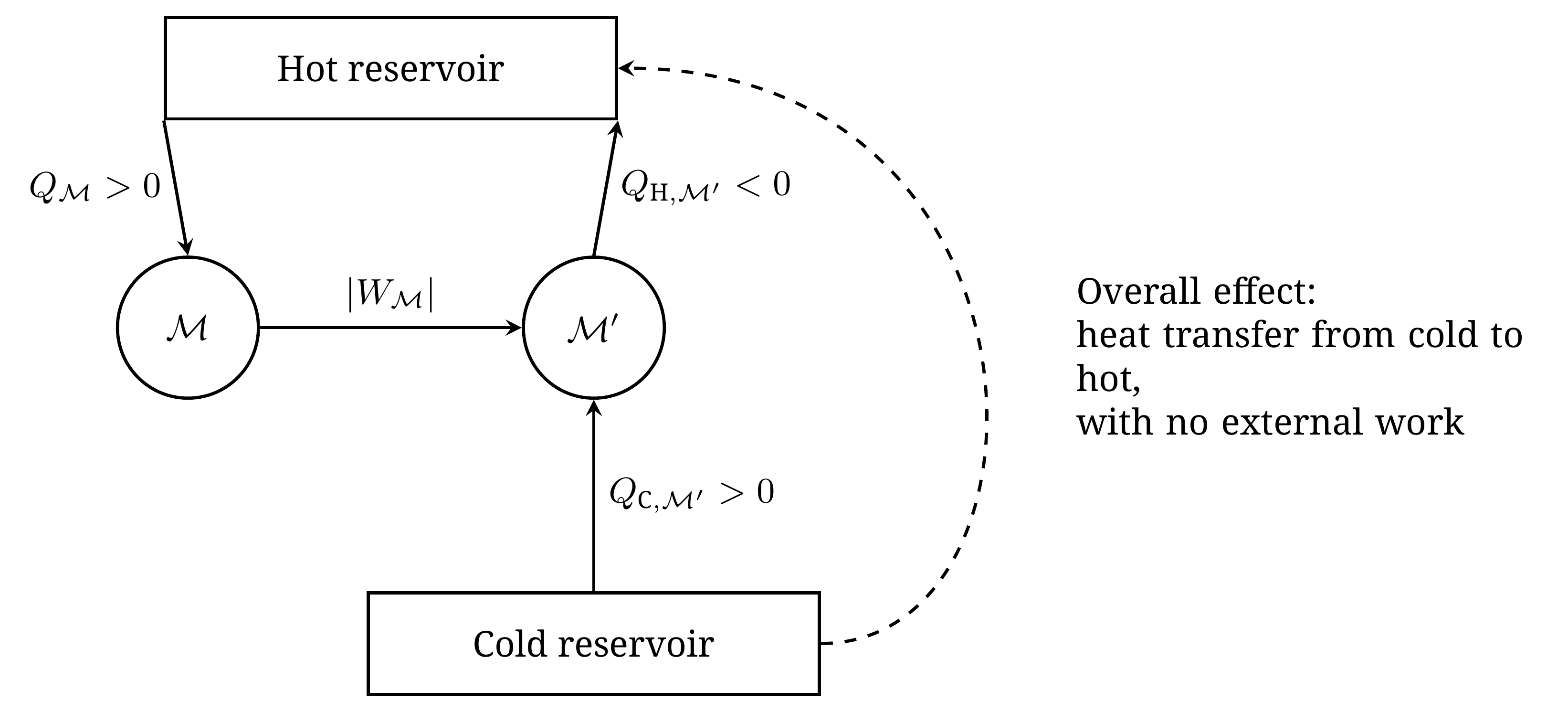
- This work is used in its entirety to drive an ordinary refrigerator operating between the two reservoirs: is adjusted so that . Over one cycle, receives the heats from the cold reservoir and from the hot reservoir. Draw a diagram of the combination between the two reservoirs, with the arrows pointing in the actual direction of the transfers. Write the first law for the cycle of .
- Calculate the total work received by the combination , then the net heat it receives from each of the two reservoirs, in terms of . Show that this combination violates the Clausius statement. Which implication between the two statements has thus been proved?
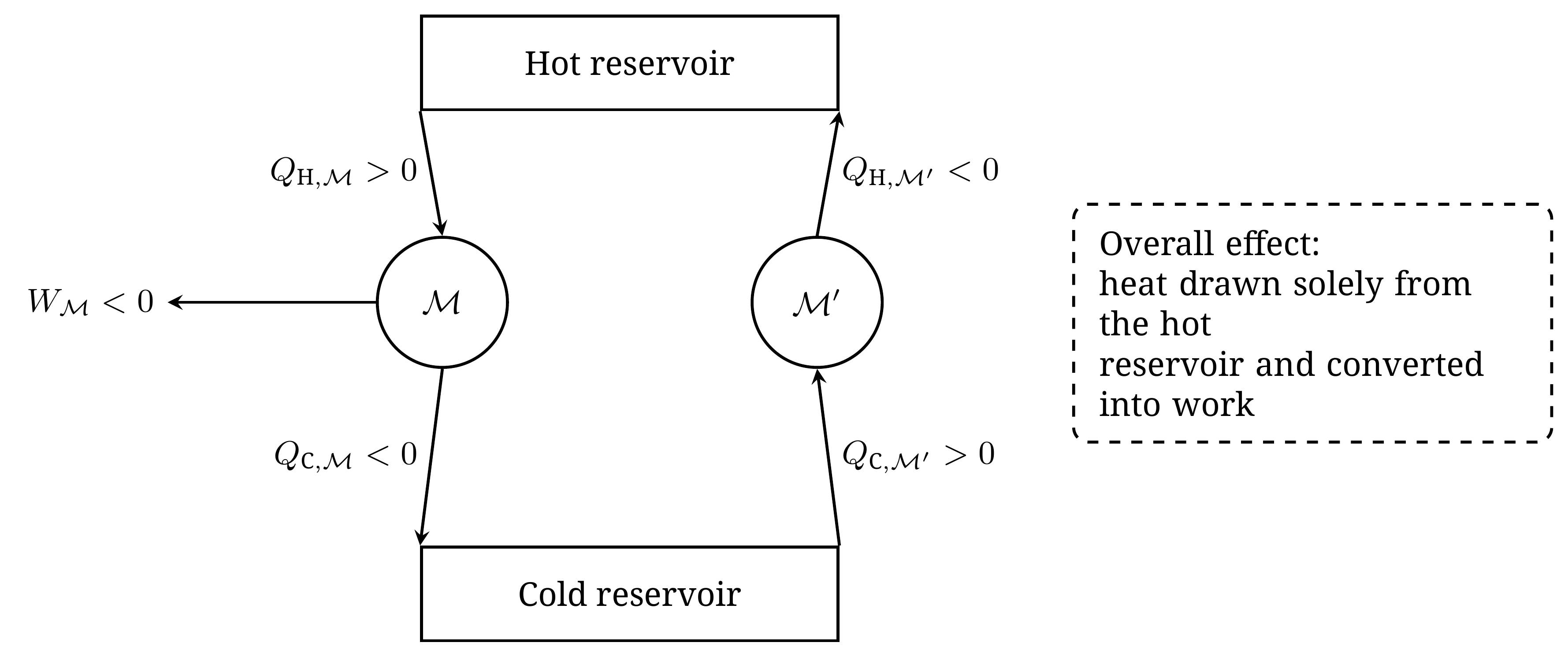
- Now suppose the Clausius statement is false. From here on, the notation and refers to two new machines. Over one cycle, the machine extracts the heat from the cold reservoir and receives the heat from the hot reservoir, without exchanging any work. It is coupled to an ordinary engine which, over one cycle, receives the heats and , and the work . is adjusted so that . Draw a diagram of the combination , then calculate the net heat received from each reservoir and the total work received.
- Show that this new combination violates the Kelvin–Planck statement. Draw a conclusion about the equivalence of the two statements.
- In each of the two arguments, why must the coupled machines complete full cycles? What would become of the balance of Question 3 if the refrigerator were adjusted so that it receives a work ?
Hint
Detailed solution
The machine supplies the work : it converts the heat extracted from the hot reservoir entirely into work. In the diagram, the heat goes from the hot reservoir to and the work goes from to . The heat goes from the cold reservoir to , and the heat goes from to the hot reservoir. The refrigerator completes a cycle, so Question 3. With the chosen adjustment, the total work received by the combination is zero: The work source therefore returns to its initial state: the weight comes back to its starting altitude. The cold reservoir exchanges heat with only; the combination receives from it From the hot reservoir, the combination receives Substitute (Question 1 and the adjustment), then use the first law for : The combination completes a cycle, since each of the two machines completes one. Its sole external effect is to extract the heat from the cold reservoir and deliver the same heat to the hot reservoir, with no work received: this is exactly the machine forbidden by the Clausius statement. In the diagram, receives from the hot reservoir, gives up to the cold reservoir and supplies the work ; extracts from the cold reservoir and delivers the same heat to the hot reservoir. From the cold reservoir, the combination receives From the hot reservoir, the combination receives The first law applied to the cycle of reads , hence Since exchanges no work, the total work received by the combination is Question 5. The combination completes a cycle. The cold reservoir returns to its initial state, since the net exchange with it is zero. The sole effect of the combination is to extract the heat from the hot reservoir, which plays the role of the single reservoir, and to convert it entirely into the work . This is the machine forbidden by the Kelvin–Planck statement.