Solved thermodynamics exercise

Sudden compression revisited: entropy balances

Exercise 26 · Lesson 6 — The Second Law of Thermodynamics

  • entropy production
  • adiabatic compression
  • irreversibility
  • isentropic
  • entropy balance
  • algebraic comparison

Statement

Revisit the two adiabatic-compression experiments from lesson 5, recalling the useful results here. A thermally insulated vertical cylinder of cross-sectional area S\mathcal S contains nn moles of ideal gas. Its piston is also insulated, moves without friction and has negligible mass. The molar heat capacities cVc_V and cPc_P are constant, with

γ=cPcV>1,cV=Rγ−1,cP=cV+R.\gamma=\frac{c_P}{c_V}>1,\qquad c_V=\frac{R}{\gamma-1},\qquad c_P=c_V+R.

Initially, only atmospheric pressure P0P_0 acts on the piston: the gas is in state A=(P0,V0,T0)A=(P_0,V_0,T_0), with P0V0=nRT0P_0V_0=nRT_0. An added load of mass MM raises the external pressure to

P1=P0+MgS=xP0,x>1.P_1=P_0+\frac{Mg}{\mathcal S}=xP_0,\qquad x>1.

Both experiments start from AA. In the first, the load is added and then removed one grain of sand at a time: the gas follows the reversible adiabat A→B→AA\to B\to A. In the second, the load is applied all at once, equilibrium B′B' is reached, then the load is removed all at once and equilibrium B"B" is reached. External pressure is constant during each sudden step: P1P_1 during loading and P0P_0 during unloading. Assume that oscillations are damped by dissipation in the gas; the piston is at rest in the initial and final states and stores no energy.
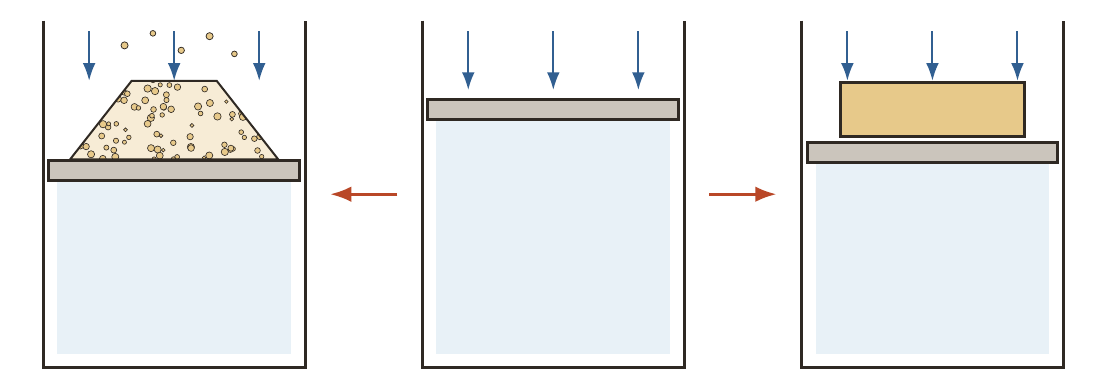
Both compressions start from A (centre). On the left, the load is gradually added until B; gradual removal returns the gas to A. On the right, the load is applied suddenly until B'; sudden removal leads to another state B”. The diagram shows the compressions; the four states are specified below.
Figure 1. Both compressions start from AA (centre). On the left, the load is gradually added until BB; gradual removal returns the gas to AA. On the right, the load is applied suddenly until B′B'; sudden removal leads to another state B"B". The diagram shows the compressions; the four states are specified below.

The adiabatic relations along the reversible path and the first law along the sudden paths gave the following results. Define

θ=1+(γ−1)xγ,φ=1+(γ−1)/xγ.StateP/P0V/V0T/T0A111Bxx−1/γx(γ−1)/γB′xθ/xθB"1θφθφ\begin{aligned} \theta=\frac{1+(\gamma-1)x}{\gamma},\qquad \phi=\frac{1+(\gamma-1)/x}{\gamma}. \begin{array}{c|ccc} \text{State} & P/P_0 & V/V_0 & T/T_0\\ \hline A & 1 & 1 & 1\\[3pt] B & x & x^{-1/\gamma} & x^{(\gamma-1)/\gamma}\\[3pt] B' & x & \theta/x & \theta\\[3pt] B" & 1 & \theta\phi & \theta\phi \end{array} \end{aligned}

In particular,

θ>x(γ−1)/γ,φ>x−(γ−1)/γ,θφ−1=γ−1γ2(x−1)2x>0.\theta>x^{(\gamma-1)/\gamma},\qquad \phi>x^{-(\gamma-1)/\gamma},\qquad \theta\phi-1=\frac{\gamma-1}{\gamma^2}\frac{(x-1)^2}{x}>0.

All steps are adiabatic: Q=0Q=0 and W=ΔU=ncV(Tf−Ti)W=\Delta U=nc_V(T_f-T_i), with energy received by the gas counted as positive. Thus,

WAB=ncVT0[x(γ−1)/γ−1],WBA=−WAB,WAB′=ncVT0(θ−1),WB′B"=ncVT0θ(φ−1).\begin{aligned} W_{AB}&=nc_VT_0\left[x^{(\gamma-1)/\gamma}-1\right], & W_{BA}&=-W_{AB},\\ W_{AB'}&=nc_VT_0(\theta-1), & W_{B'B"}&=nc_VT_0\theta(\phi-1). \end{aligned}

The reversible round trip has zero net work, whereas the sudden path receives WAB′B"=ncVT0(θφ−1)>0W_{AB'B"}=nc_VT_0(\theta\phi-1)>0.

  1. Calculate the entropy changes along A→BA\to B and B→AB\to A, then establish the entropy balance for the reversible round trip.
  2. Calculate ΔSAB′\Delta S_{AB'} and show that it is strictly positive. How much of this change is exchanged and how much is produced?
  3. Do the same for sudden unloading B′→B"B'\to B".
  4. Calculate ΔSAB"\Delta S_{AB"} directly and verify that it equals the sum of the two preceding entropy productions. Does the path A→B′→B"A\to B'\to B" constitute a cycle for the gas?
  5. Compare the energy and entropy balances of both round trips. Explain why the absence of heat exchange does not imply entropy conservation.

Hint

Hint
Between two equilibrium states of an ideal gas,

ΔS=ncVln⁡TfTi+nRln⁡VfVi.\Delta S=nc_V\ln\frac{T_f}{T_i}+nR\ln\frac{V_f}{V_i}.

For B′→B"B'\to B", use TB"/TB′=φT_{B"}/T_{B'}=\phi and VB"/VB′=xφV_{B"}/V_{B'}=x\phi. The inequalities recalled in the problem determine the signs. At each step, Se=0S_{\mathrm{e}}=0.

Detailed solution

Solution
Question 1. The table gives TB/T0=x(γ−1)/γT_B/T_0=x^{(\gamma-1)/\gamma} and VB/V0=x−1/γV_B/V_0=x^{-1/\gamma}. Substituting into the entropy formula gives

ΔSAB=ncVln⁡(x(γ−1)/γ)+nRln⁡(x−1/γ)=ncVγ−1γln⁡x−nRγln⁡x=nγ[cV(γ−1)−R]ln⁡x=0,\begin{aligned} \Delta S_{AB} &=nc_V\ln\left(x^{(\gamma-1)/\gamma}\right) +nR\ln\left(x^{-1/\gamma}\right)\\ &=nc_V\frac{\gamma-1}{\gamma}\ln x-\frac{nR}{\gamma}\ln x\\ &=\frac n\gamma[c_V(\gamma-1)-R]\ln x=0, \end{aligned}

because cV(γ−1)=Rc_V(\gamma-1)=R. The return follows the same path in the opposite direction, so ΔSBA=0\Delta S_{BA}=0. For each step and the full round trip, Se=Si=ΔS=0S_{\mathrm{e}}=S_{\mathrm{i}}=\Delta S=0. The gas returns to its state AA.

Question 2. For the sudden compression, TB′/T0=θT_{B'}/T_0=\theta and VB′/V0=θ/xV_{B'}/V_0=\theta/x. Using R=cV(γ−1)R=c_V(\gamma-1) followed by the logarithm rules gives

ΔSAB′=ncVln⁡θ+nRln⁡θx=ncV[ln⁡θ+(γ−1)(ln⁡θ−ln⁡x)]=ncV[γln⁡θ−(γ−1)ln⁡x]=ncVln⁡(θγxγ−1).\begin{aligned} \Delta S_{AB'} &=nc_V\ln\theta+nR\ln\frac{\theta}{x}\\ &=nc_V[\ln\theta+(\gamma-1)(\ln\theta-\ln x)]\\ &=nc_V[\gamma\ln\theta-(\gamma-1)\ln x]\\ &=nc_V\ln\left(\frac{\theta^\gamma}{x^{\gamma-1}}\right). \end{aligned}

The given inequality θ>x(γ−1)/γ\theta>x^{(\gamma-1)/\gamma} implies θγ>xγ−1\theta^\gamma>x^{\gamma-1}: the ratio inside the logarithm exceeds 1, hence ΔSAB′>0\Delta S_{AB'}>0. No entropy is exchanged, so Si,AB′=ΔSAB′S_{\mathrm{i},AB'}=\Delta S_{AB'}. The gas's entropy increases through production without receiving heat.

Question 3. During sudden unloading, the ratios between this step's final and initial states are

TB"TB′=θφθ=φ,VB"VB′=θφθ/x=xφ.\frac{T_{B"}}{T_{B'}}=\frac{\theta\phi}{\theta}=\phi, \qquad \frac{V_{B"}}{V_{B'}}=\frac{\theta\phi}{\theta/x}=x\phi.

Thus,

ΔSB′B"=ncVln⁡φ+nRln⁡(xφ)=ncV[ln⁡φ+(γ−1)(ln⁡x+ln⁡φ)]=ncV[γln⁡φ+(γ−1)ln⁡x]=ncVln⁡(φγxγ−1)>0.\begin{aligned} \Delta S_{B'B"} &=nc_V\ln\phi+nR\ln(x\phi)\\ &=nc_V[\ln\phi+(\gamma-1)(\ln x+\ln\phi)]\\ &=nc_V[\gamma\ln\phi+(\gamma-1)\ln x]\\ &=nc_V\ln\left(\phi^\gamma x^{\gamma-1}\right)>0. \end{aligned}

Indeed, φ>x−(γ−1)/γ\phi>x^{-(\gamma-1)/\gamma} implies φγxγ−1>1\phi^\gamma x^{\gamma-1}>1. Again Se=0S_{\mathrm{e}}=0 and Si,B′B"=ΔSB′B"S_{\mathrm{i},B'B"}=\Delta S_{B'B"}. The gas cools during this expansion (φ<1\phi<1), but its entropy increases: the volume-increase term dominates.

Question 4. States AA and B"B" have the same pressure and TB"/T0=VB"/V0=θφT_{B"}/T_0=V_{B"}/V_0=\theta\phi, hence

ΔSAB"=ncVln⁡(θφ)+nRln⁡(θφ)=ncPln⁡(θφ)>0.\Delta S_{AB"}=nc_V\ln(\theta\phi)+nR\ln(\theta\phi) =nc_P\ln(\theta\phi)>0.

We used cP=cV+Rc_P=c_V+R and θφ>1\theta\phi>1. Now add the two preceding results:

ΔSAB′+ΔSB′B"=ncV[γln⁡θ−(γ−1)ln⁡x+γln⁡φ+(γ−1)ln⁡x]=ncVγ(ln⁡θ+ln⁡φ)=ncPln⁡(θφ)=ΔSAB".\begin{aligned} \Delta S_{AB'}+\Delta S_{B'B"} &=nc_V[\gamma\ln\theta-(\gamma-1)\ln x\\ &\qquad+\gamma\ln\phi+(\gamma-1)\ln x]\\ &=nc_V\gamma(\ln\theta+\ln\phi)\\ &=nc_P\ln(\theta\phi)=\Delta S_{AB"}. \end{aligned}

The ln⁡x\ln x terms cancel. Since each step is adiabatic, this sum also equals the sum of the two entropy productions. Returning the external pressure to P0P_0 is not enough to complete a gas cycle: B"≠AB"\ne A, since TB">T0T_{B"}>T_0 and VB">V0V_{B"}>V_0.

Question 5. For A→B→AA\to B\to A, Qtot=Wtot=ΔUtot=0Q_{\mathrm{tot}}=W_{\mathrm{tot}}=\Delta U_{\mathrm{tot}}=0 and Si,tot=0S_{\mathrm{i},\mathrm{tot}}=0. For A→B′→B"A\to B'\to B",

Qtot=0,Wtot=ΔUtot=ncVT0(θφ−1)>0,Se,tot=0,Si,tot=ΔStot=ncPln⁡(θφ)>0.Q_{\mathrm{tot}}=0,\qquad W_{\mathrm{tot}}=\Delta U_{\mathrm{tot}}=nc_VT_0(\theta\phi-1)>0, S_{\mathrm{e},\mathrm{tot}}=0,\qquad S_{\mathrm{i},\mathrm{tot}}=\Delta S_{\mathrm{tot}}=nc_P\ln(\theta\phi)>0.

The first law describes the net work retained as internal energy; the second quantifies irreversibility through entropy production. An adiabatic process is isentropic only if it produces no entropy, as in the reversible case here.