Solved thermodynamics exercise
The Clausius inequality for an arbitrary number of reservoirs
Exercise 34 · Lesson 6 — The Second Law of Thermodynamics
- Clausius inequality
- Kelvin--Planck statement
- reversible machine
- thermal reservoirs
- global reversibility
- local reversibility
- auxiliary machine
Statement
A machine completes a cycle during which it exchanges heat with thermal reservoirs at temperatures , and work with an ideal work source, for example a weight whose altitude alone changes. In the banker's convention, is the heat received by from the reservoir over one cycle, and the work received. We want to prove the Clausius inequality
We take for granted the Kelvin–Planck statement of the second law: no cyclic process is possible whose sole effect is to extract heat from a single reservoir and convert it entirely into work. We also take for granted the result of Carnot's theorems: a locally reversible two-reservoir engine operating between and has the efficiency . Finally, the size of a machine can be adjusted, for example through the amount of fluid it contains: its heats and its work over one cycle are then multiplied by the same positive factor.
- Consider a locally reversible two-reservoir engine that receives the heats and over one cycle. Show that the expression for its efficiency is equivalent to Show that this relation still holds when the machine is run in reverse. Deduce that every locally reversible two-reservoir machine operating between two temperatures , and receiving the heats and from them, satisfies , whatever the order of the temperatures and the direction of operation.
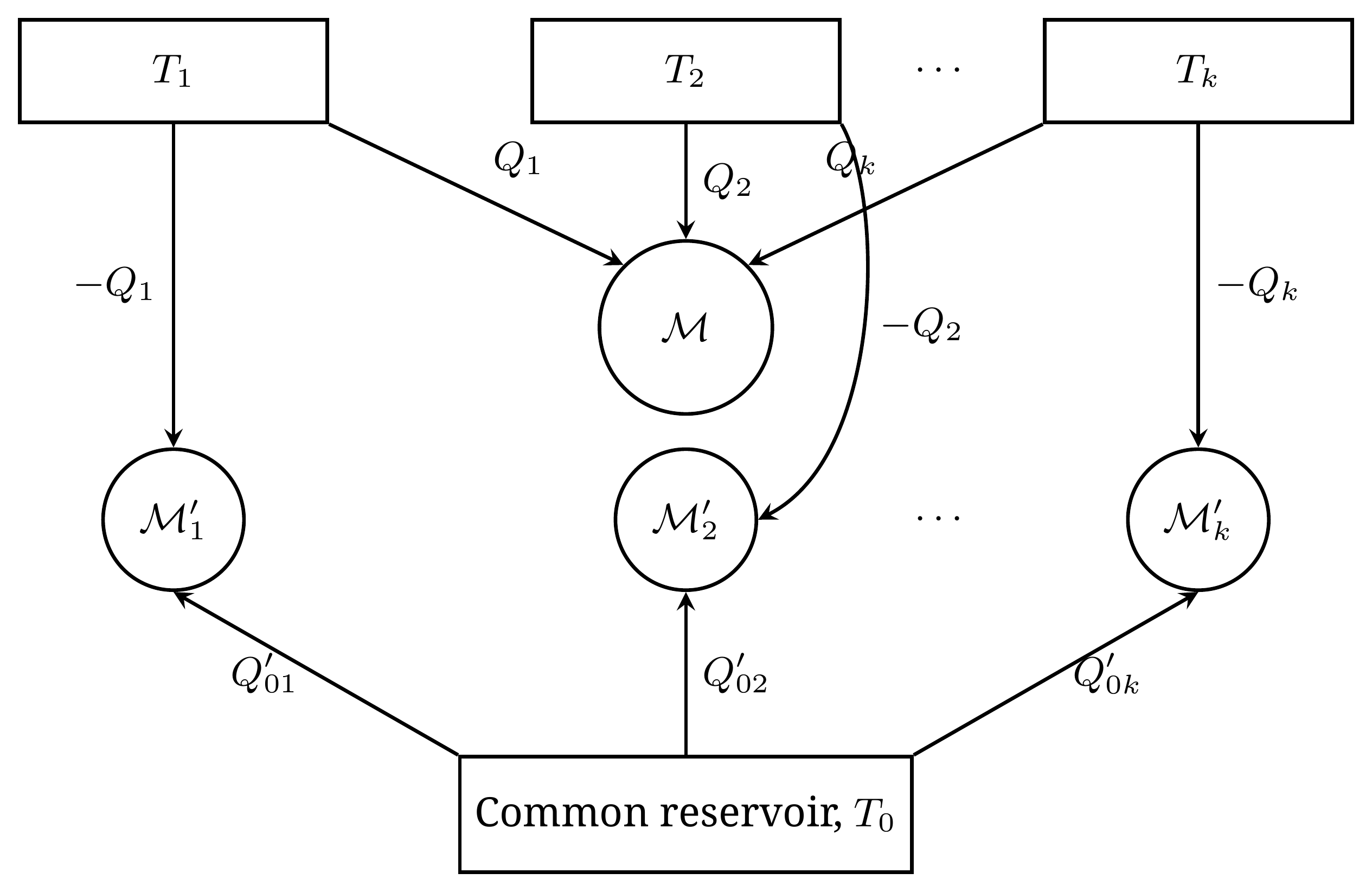
- Choose a reference temperature , distinct from all the , and a reservoir at this temperature. With each reservoir , associate a locally reversible two-reservoir machine operating between and , adjusted to receive the heat from the reservoir . Express, in terms of , and , the heat that receives from the reservoir , then the work it receives.
- Depending on the signs of and of , the machine operates as an engine or as a refrigerator. Draw up a table of the four possible cases. Why can the temperature be chosen arbitrarily with respect to the ?
- Consider the composite machine formed by and all the machines . Show that it completes a cycle and that the reservoirs return to their initial states. Express the total heat it receives from the reservoir and the total work it receives, in terms of and of the sum .
- By applying the Kelvin–Planck statement to the composite machine, prove the Clausius inequality. Does the case contradict the second law?
- Suppose that the cycle of is locally reversible. Show that .
- Conversely, suppose . Show that the cycle of is globally reversible. Can one conclude that it is locally reversible?
Hint
Detailed solution
The equality is equivalent to . Multiply both sides by : When the locally reversible machine is run in reverse, all its exchanges change sign: it receives and . The relation becomes , which is the same relation multiplied by . It therefore holds in both directions of operation. Finally, the expression is symmetric under exchange of the two reservoirs: the index may denote either the hot reservoir or the cold reservoir. The relation therefore holds for every locally reversible two-reservoir machine, whatever the order of the temperatures. In the diagram, the arrows point towards the machines, in accordance with the banker's convention; when a heat is negative, the actual transfer takes place in the direction opposite to the arrow. The relation of Question 1, applied to between and , gives Substitute and solve for : The first law applied to the cycle of reads , hence The assumption ensures that operates between two distinct temperatures, which allows Question 1 to be applied. For a finite number of reservoirs, such a choice of is always possible. The last column gives the actual direction of the heat transfer. In each case, heat flows from hot to cold when the machine supplies work, and from cold to hot when it receives work. Each is locally reversible and can therefore operate in either direction. The position of relative to only determines, for each , whether the machine is an engine or a refrigerator. Each reservoir therefore returns to its initial state. From the reservoir , the composite machine receives The first law applied to the cycle of gives . The total work received by the composite machine is therefore The sums cancel. This is the first law applied directly to the composite machine, whose only uncompensated heat exchange takes place with . The case corresponds to : the composite machine receives work and gives it up entirely as heat to the reservoir , like a resistive heater. The second law allows this conversion of work into heat. The sum is both non-positive and non-negative: .