Solved thermodynamics exercise
Work and heat between two states along two paths
Exercise 11 · Lesson 5 — Application to the Ideal Gas
- pressure work
- heat
- isotherm
- isochoric transformation
- Clapeyron diagram
- exact differential
- ideal gas
Statement
Consider moles of a monatomic ideal gas with internal energy . State is connected to state by two quasi-static paths, with at all times:
- : an isothermal expansion at , from to , followed by an isochoric transformation at , from to ;
- : an isochoric transformation at , from to , followed by an isothermal expansion at , from to .
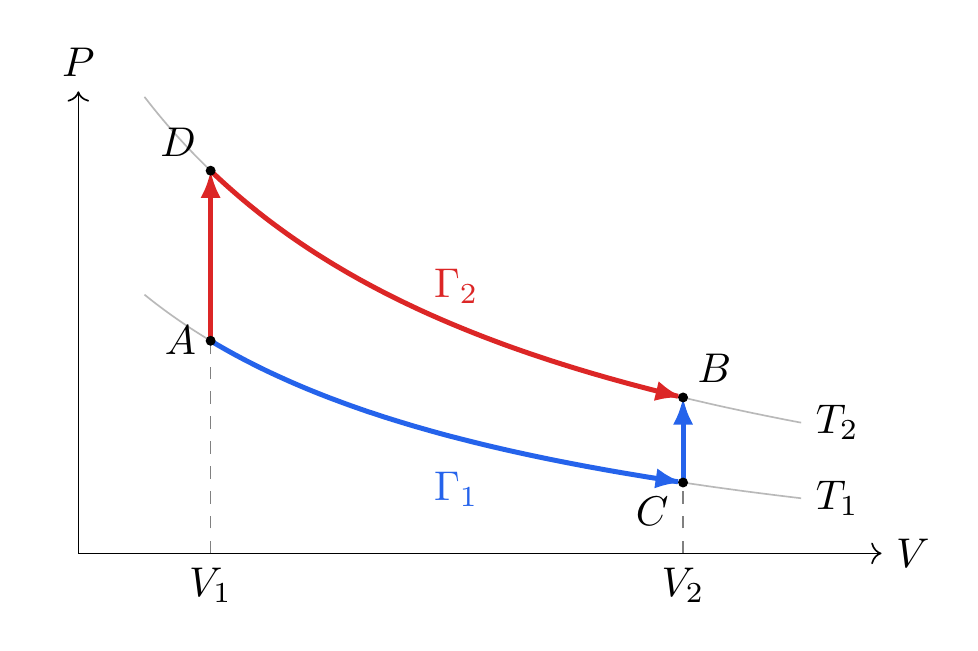
- For and , plot paths and in the Clapeyron diagram . Indicate the intermediate states and the direction of travel.
- Calculate the work received, and , along each of the two paths. What is their difference ?
- Without evaluating the two integrals separately, recover geometrically from the area between the two paths in the Clapeyron diagram.
- Calculate along each of the two paths, then deduce and . Conclude as to the nature of .
- Numerical application: mol, K, K, and .
Hint
Detailed solution
Since , the isotherm lies above the isotherm . Path runs from to , to the right along the lower isotherm , then vertically from to along the isochore . Path first rises vertically from to along the isochore , then runs to the right from to along the upper isotherm . The arrows on the two paths are therefore Question 2. Using the convention that work received by the gas is positive, . An isochoric transformation makes no contribution and, along an isotherm at temperature , We therefore obtain and then The initial and final states are identical, but the works differ: is not an exact differential. Question 3. The isochores sweep out no area. Since the work received is the negative of the area under the curve, the difference is the area between the isotherms and : This recovers the result of Question 2. Question 4. The internal energy of the monatomic ideal gas depends only on temperature. Its change is therefore the same along both paths: The first law, , gives , hence Thus, The heat exchanged also depends on the path: is not an exact differential, unlike . Question 5. With , The gas does twice as much work during and receives the corresponding additional heat.