Solved thermodynamics exercise

Triangular cycle

Exercise 12 · Lesson 5Application to the Ideal Gas

  • power cycle
  • Clapeyron diagram
  • cycle area
  • first law
  • efficiency

Statement

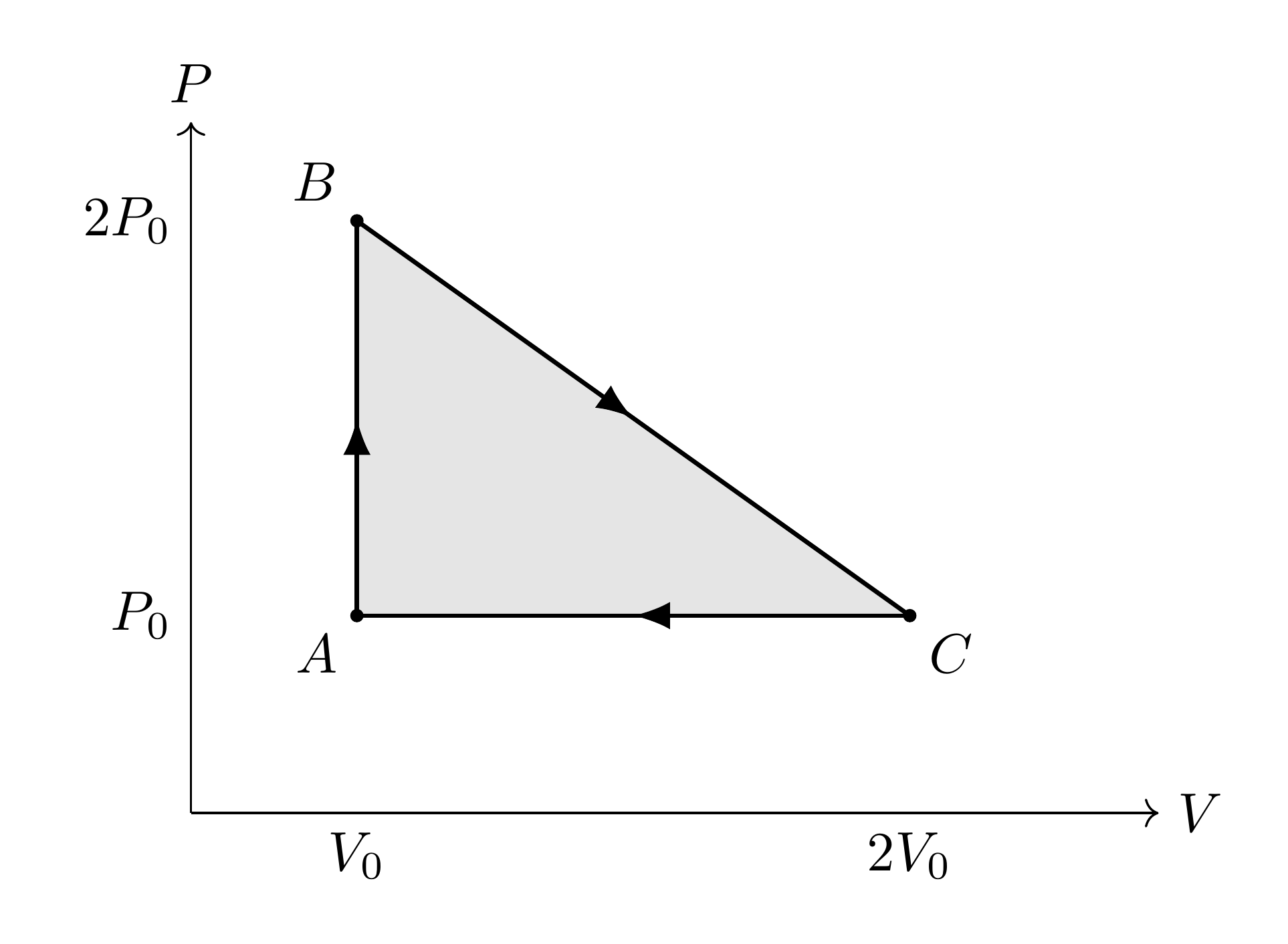
Consider nn moles of an ideal gas with constant molar heat capacity cVc_V undergoing the quasi-static cycle ABCAA\to B\to C\to A, with

A=(P0,V0),B=(2P0,V0),C=(P0,2V0).A=(P_0,V_0), \qquad B=(2P_0,V_0), \qquad C=(P_0,2V_0).

Branch ABA\to B is isochoric, branch BCB\to C is a straight-line segment in the (P,V)(P,V) plane, and branch CAC\to A is isobaric.

For a power cycle, the efficiency is defined by

η=WfourniQin=WcycleQin,\eta=\frac{W_{\mathrm{fourni}}}{Q_{\mathrm{in}}} =\frac{-W_{\mathrm{cycle}}}{Q_{\mathrm{in}}},

where QinQ_{\mathrm{in}} is the sum of the elementary heat transfers δQ>0\delta Q>0 received by the gas during the cycle.

  1. Plot the cycle in the Clapeyron diagram and specify its direction of travel. Is it a power or refrigeration cycle?
  2. Determine the equation P(V)P(V) of the line connecting BB to CC.
  3. Letting T0=P0V0/(nR)T_0=P_0V_0/(nR), determine the temperatures TAT_A, TBT_B, and TCT_C. Why is ΔUBC\Delta U_{B\to C} zero even though this branch is not isothermal?
  4. Calculate the work received along each of the three branches, then over the complete cycle. Recover the absolute value of the total work from the area of the triangle.
  5. Calculate ΔU\Delta U and QQ along each branch in terms of P0P_0, V0V_0, and cVc_V only, then verify that ΔUcycle=0\Delta U_{\mathrm{cycle}}=0 and Qcycle=WcycleQ_{\mathrm{cycle}}=-W_{\mathrm{cycle}}.
  6. Letting a=cVR>1a = \frac{c_V}{R} >1 and x=V/V0x = V/V_0, show that the sign of δQ\delta Q changes at a point on branch BCB\to C. Deduce QinQ_{\mathrm{in}}, then the efficiency η\eta of this cycle. Give its value for a monatomic ideal gas, for which cV=32Rc_V=\frac32R.

Hint

Hint
Along BCB\to C, seek P(V)=aV+bP(V)=aV+b by requiring the line to pass through BB and CC. To calculate a change in internal energy, only the temperatures at the ends of the branch are required. For Question 6, use the differential form of the first law.

Detailed solution

Solution
Questions 1—2. The cycle runs clockwise: it is a power cycle. The equation of the line BCB\to C is

P(V)=P0(3VV0).P(V)=P_0\left(3-\frac{V}{V_0}\right).
The triangular cycle A B C A in the Clapeyron diagram.
Figure 1. The triangular cycle ABCAA\to B\to C\to A in the Clapeyron diagram.

Question 3. The equation of state gives

TA=T0,TB=TC=2T0.T_A=T_0, \qquad T_B=T_C=2T_0.

The temperature varies along BCB\to C, but returns to the same value at both endpoints. Since the internal energy of an ideal gas depends only on temperature for a fixed amount of substance, ΔUBC=0\Delta U_{B\to C}=0.

Question 4. The works received are

WAB=0,WBC=V02V0P(V)dV=32P0V0,WCA=P0ΔV=P0V0.W_{AB}=0, \qquad W_{BC}=-\int_{V_0}^{2V_0}P(V)\,dV=-\frac32P_0V_0, \qquad W_{CA}=-P_0 \Delta V = P_0V_0.

Thus,

Wcycle=12P0V0.\boxed{W_{\mathrm{cycle}}=-\frac12P_0V_0}.

Its sign is negative: the gas does work over the cycle. Its absolute value is indeed the area of the triangle, with base V0V_0 and height P0P_0, from the formula A=12base×heightA=\frac12\text{base}\times\text{height} for a right triangle.

Question 5. Since nRT0=P0V0nRT_0=P_0V_0,

BranchWΔUQ=ΔUWAB0cVRP0V0cVRP0V0BC32P0V0032P0V0CAP0V0cVRP0V0(cVR+1)P0V0\begin{aligned} \begin{array}{c|c|c|c} \text{Branch} & W & \Delta U & Q=\Delta U-W\\ \hline A\to B & 0 & \dfrac{c_V}{R}P_0V_0 & \dfrac{c_V}{R}P_0V_0\\[4pt] B\to C & -\dfrac32P_0V_0 & 0 & \dfrac32P_0V_0\\[4pt] C\to A & P_0V_0 & -\dfrac{c_V}{R}P_0V_0 & -\left(\dfrac{c_V}{R}+1\right)P_0V_0 \end{array} \end{aligned}

Summing the three branches gives

ΔUcycle=0,Qcycle=12P0V0=Wcycle.\boxed{ \Delta U_{\mathrm{cycle}}=0, \qquad Q_{\mathrm{cycle}}=\frac12P_0V_0=-W_{\mathrm{cycle}}. }

Question 6. Let a=cV/Ra=c_V/R and x=V/V0x=V/V_0. Along branch BCB\to C, P=P0(3x)P=P_0(3-x) and T=T0(3xx2)T=T_0(3x-x^2). The first law gives

δQ=dUδW=P0V0[3(a+1)(2a+1)x]dx.\delta Q=\mathrm{d}U-\delta W =P_0V_0\left[3(a+1)-(2a+1)x\right]\mathrm{d}x.

This elementary heat transfer vanishes at

x=3(a+1)2a+1.x_\star=\frac{3(a+1)}{2a+1}.

When a>1a>1, we have 1<x<21<x_\star<2: the gas receives heat from BB to the point with abscissa xx_\star, then releases heat up to CC. It also receives the heat QAB=aP0V0Q_{AB}=aP_0V_0 along ABA\to B. Consequently,

Qin=P0V0[a+1x(3(a+1)(2a+1)x)dx]=P0V0[a+(a+2)22(2a+1)].\begin{aligned} Q_{\mathrm{in}} &=P_0V_0\left[ a+\int_1^{x_\star}\left(3(a+1)-(2a+1)x\right)\mathrm{d}x \right]\\ &=P_0V_0\left[a+\frac{(a+2)^2}{2(2a+1)}\right]. \end{aligned}

The efficiency is therefore

η=12P0V0Qin=2a+15a2+6a+4,a=cVR.\boxed{ \eta =\frac{\frac12P_0V_0}{Q_{\mathrm{in}}} =\frac{2a+1}{5a^2+6a+4}, \qquad a=\frac{c_V}{R}. }

For a monatomic ideal gas, a=32a=\frac32, hence

η=169716,5%.\eta=\frac{16}{97}\simeq16{,}5\,\%.