Semipermeable membrane: which quantities become equal?
Exercise 25 · Lesson 6 — The Second Law of Thermodynamics
equilibrium
semipermeable membrane
chemical potential
partial pressure
fixed partition
movable partition
Statement
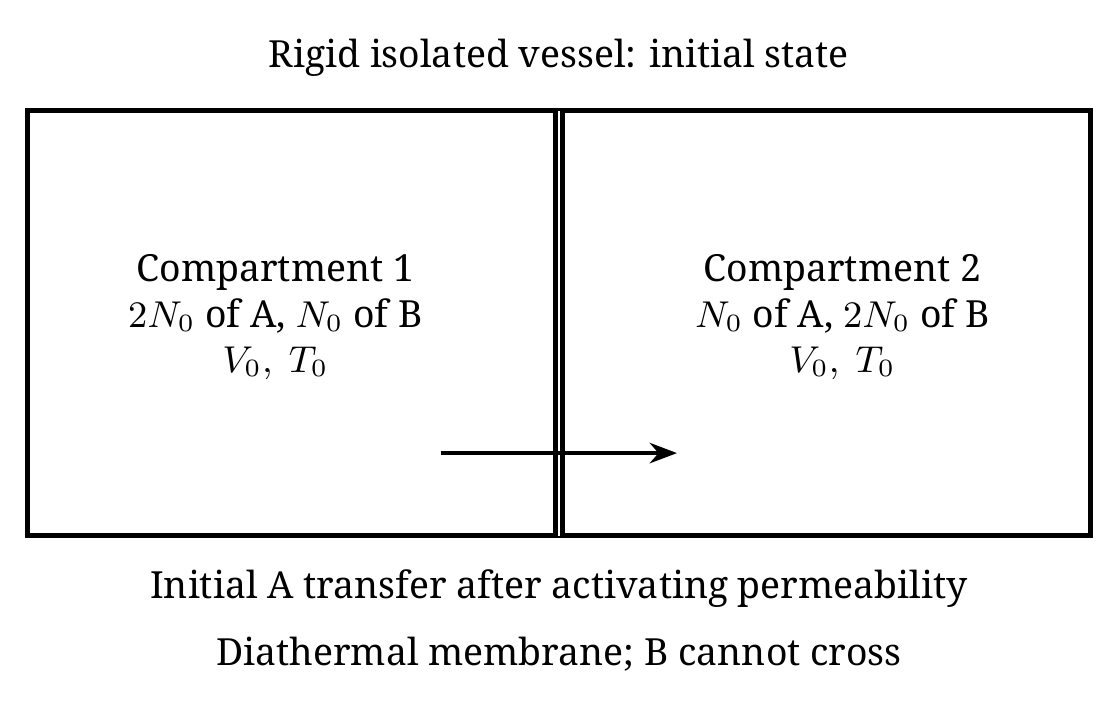
A rigid, isolated vessel of volume 2V0 contains two mixtures of monatomic ideal gases A and B. A diathermal membrane separates them. It allows A through, but not B. Initially held fixed and made impermeable, it divides the vessel into equal volumes V0 at the same temperature T0. On the left are 2N0 particles of A and N0 of B; on the right, N0 of A and 2N0 of B. Its selective permeability is then activated. Neglect the membrane's energy and interactions between particles.
For this exercise, accept the extension of the thermodynamic identity to variable particle numbers:
dU=TdS−PdV+μAdNA+μBdNB.
μs is the chemical potential per particle of species s. Also accept, for each ideal mixture,
U=23(NA+NB)kBT,P=pA+pB,ps=VNskBT.
The chemical potential of species s∈{A,B} is
μs(T,ps)=μs∘(T)+kBTlnp∘ps,
where p∘ is a reference pressure.
Sketch the vessel and its constituents. Compare the initial total pressures, then the partial pressures of A. Use the chemical potentials to predict the initial direction of A transfer.
The membrane remains fixed. Express dStot in terms of the allowed redistributions dU1 and dNA,1, then deduce the stationarity conditions. Must the total pressures or the μB be equal?
Determine the final temperature, the numbers of A particles and the total pressures. At temperature T0, verify that the distribution of A found maximizes entropy with respect to A transfer.
Starting from this state, release the membrane. It moves without friction or any additional force and remains diathermal and selective. What additional condition applies? Determine the new equilibrium: volumes, numbers of A particles, temperature and common total pressure.
Numerical application: N0=NAn0, with n0=1,0mol,V0=10L and T0=300K. Recall the relation R=NAkB and use
NA=6,022×1023mol−1,kB=1,380649×10⁻²³JK−1.
For the fixed and then the movable membrane, calculate the final pressures and the amounts of A on each side (in moles), together with the final volumes when the membrane is movable.
Hint
Hint
At fixed volume, dS=dU/T−μAdNA/T if B does not cross the membrane. Transfers received by one side are lost by the other. When the membrane is movable, add the term (P1/T1−P2/T2)dV1.
Detailed solution
Solution
Figure 1
Question 1. The diagram distinguishes the two species and shows that only A can cross. Set P∗=N0kBT0/V0. Each compartment initially contains 3N0 particles:
For A's partial pressure, count only A particles: 2N0 on the left and N0 on the right. Initially P1,i=P2,i=3P∗, but pA,1,i=2P∗ and pA,2,i=P∗. Thus μA,1−μA,2=kBT0ln2>0: A initially moves from left to right. For dNA,1<0 at equal temperatures, the total entropy change (μA,2−μA,1)dNA,1/T0 is positive. Equal total pressures do not suffice to stop diffusion. In the chemical-potential difference, the two μA∘(T0) terms cancel; combining the logarithms gives kBT0ln(pA,1,i/pA,2,i)=kBT0ln2.
Question 2. Total energy and the total number of A particles are conserved; the numbers of B particles on each side are constant. Using dU2=−dU1,dNA,2=−dNA,1 and dNB,1=dNB,2=0 gives
dSj=TjdUj−TjμA,jdNA,j(j=1,2).
The volume term vanishes because the membrane is fixed. Adding gives
Heat conduction and A transfer are allowed: their variations can be tested independently. Stationarity therefore requires 1/T1−1/T2=0, or T1=T2, followed by (μA,2−μA,1)/T=0, or μA,1=μA,2. It requires neither P1=P2 (the membrane is fixed) nor μB,1=μB,2 (B cannot cross).
Question 3. Initially the total energy is 9N0kBT0 and the total number of particles remains 6N0. Indeed, Ui=(3/2)(3N0+3N0)kBT0=9N0kBT0. At a common final temperature T,Uf=(3/2)(6N0)kBT=9N0kBT. Equality Uf=Ui therefore gives T=T0. Equality of A's chemical potentials becomes
kBT0lnp∘pA,1=kBT0lnp∘pA,2.
Dividing by kBT0 and exponentiating gives pA,1=pA,2. Since the volumes are equal, the factors kBT0/V0 cancel: NA,1=NA,2. Since NA,1+NA,2=3N0, each equals 3N0/2. Adding the B particles gives
The energy term cancels because the temperatures are equal and dU1+dU2=0. To differentiate again, write ln(3N0−a)−lna: its derivative is −1/(3N0−a)−1/a. Thus,
The equal distribution is the unique maximum on 0<a<3N0.
Question 4. Stationarity with respect to volume adds P1=P2: the additional term in dStot is (P1/T1−P2/T2)dV1. Its coefficient must vanish; with T1=T2, this requires equal total pressures. The final temperature is again T0, from the same energy balance as in question 3. Since pA,1=pA,2, equal total pressures imply pB,1=pB,2. B cannot cross:
V1N0=V22N0,V1+V2=2V0,
so V2=2V1, then 3V1=2V0: V1=2V0/3 and V2=4V0/3. For A, equal partial pressures give NA,1/V1=NA,2/V2, hence NA,2=2NA,1. Since the sum is 3N0, we obtain NA,1=N0 and NA,2=2N0. Finally, Pf=(N0+N0)kBT0/(2V0/3)=3P∗. The results are therefore
Equal B partial pressures follow here from the other conditions and the ideal-mixture model, rather than from an allowed exchange of B. The amounts of A are no longer equal: their concentrations, and hence their partial pressures, become equal.
Question 5. Convert the volumes to SI units to calculate pressures: V0=10L=10−2m3. The constant NA converts an amount of substance to a particle number: N0=NAn0 with n0=1,0mol. First calculate
R=NAkB=(6,022×1023)(1,380649×10⁻²³)≃8,314Jmol−1K−1.
With N0kB=n0R, the pressure scale introduced in question 1 is
because 1bar=105Pa. This pressure is a calculation scale; it is not itself a compartment's total pressure.
Fixed membrane. Each volume remains 10L. Question 3 gives NA,1=NA,2=3N0/2. To convert particles to moles, divide by NA:
nA,1=nA,2=2NA3N0=23×1mol=1,5mol.
B cannot cross the membrane: 1mol of B remains on the left and 2mol on the right. The total amounts are therefore 2,5mol and 3,5mol. At T0=300K, the equation P=nRT/V gives separately
The total pressures differ; fixing the membrane maintains this state. A's partial pressures are equal because A occupies equal volumes with equal amounts and temperatures.
Movable membrane. From question 4,
V1,f=32V0=32×10≃6,67L,V2,f=34V0=34×10≃13,33L.
The sum remains 20L, the vessel's volume. The A populations are now NA,1=N0 and NA,2=2N0:
nA,1=NAN0=1mol,nA,2=NA2N0=2mol.
The total is indeed 3mol of A. Adding B, the compartments contain 2 and 4mol of gas respectively. Use the exact volumes before rounding: