Solved thermodynamics exercise
Adiabatic compression: gradual or sudden
Exercise 16 · Lesson 5 — Application to the Ideal Gas
- adiabatic compression
- reversible transformation
- irreversible transformation
- constant external pressure
- work
Statement
This exercise is much more than a standard textbook problem: it is also fundamental to demonstrating one of the differences between a reversible transformation and an irreversible transformation (see also Lesson 6).
Consider moles of an ideal gas, with constant heat capacities and ratio , enclosed in a thermally insulated vertical cylinder of cross-sectional area , closed by a thermally insulated piston of negligible mass that moves without friction. The surroundings are at atmospheric pressure , which acts on the upper face of the piston. At initial equilibrium, the gas pressure is therefore also , and its state is
A load of total mass is available. When it is placed entirely on the piston, the external pressure is
Two experiments are compared: either the mass is divided into a large number of small masses added one by one, with each new equilibrium allowed to be reached; or the entire mass is placed on the piston all at once. The load is then removed in the same manner: either grain by grain, or all at once.
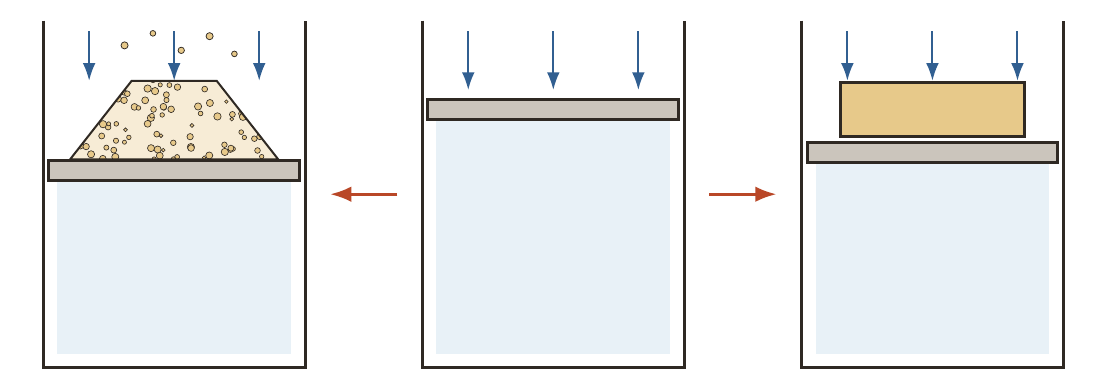
- The load is added very gradually, so that the external pressure increases slowly from to . Justify why the gas pressure equals the external pressure at every instant. What law can then be used to relate the successive states of the gas? Deduce , , and in terms of and .
- Starting now from state , the load is removed very gradually, grain by grain, until the external pressure returns to . Using the same law as in the previous question, show that the gas returns exactly to its initial state .
- Starting again from , the mass is now placed on the piston all at once: the external pressure suddenly takes the constant value . Determine the final state completely, as well as , , and .
- First take the example and to compare and numerically. Then establish the comparison analytically for all and all , and compare with . Which of the two compressions heats the gas more, and which compresses it more?
- From , the entire load is removed suddenly: the external pressure returns to atmospheric pressure . Determine the final state . Show whether and are greater or less than their initial values.
- Perform the energy balance for the round trip . Explain what Lesson 6 will add to this comparison.
Hint
Detailed solution
Question 1. The load is divided into sufficiently small masses, and each new equilibrium is reached before the next one is added: the gas therefore passes through a continuous succession of equilibrium states, so the transformation is quasi-static. Because the piston has negligible mass and moves without friction, mechanical equilibrium at every instant requires , hence . Because the walls are thermally insulated, . Under these conditions, Laplace's laws may therefore be used. Two useful forms between and are Since , the first relation directly gives , while the second gives . Finally, , , and . Question 2. As the load is removed gradually, the gas remains in mechanical equilibrium with the surroundings and follows the same Laplace adiabat, but in the reverse direction. At the end, . Laplace's laws then give and The gas therefore returns exactly to state . The transformation can be traversed in both directions while passing through the same succession of equilibrium states: the transformation is said to be reversible. Question 3. Laplace's laws must not be used: during this sudden transformation, the gas does not pass through a succession of equilibrium states. During the process, only the constant external pressure enters the work expression: . At final equilibrium, . Using , , , and , the first law gives Let Then Question 4. Begin with the example and . The gradual compression gives , whereas the sudden compression gives In this example, the sudden compression therefore heats the gas more. Let us show that this result is general. Set We have , and For and , all the factors in the denominator are positive and . Thus , so , that is, . The two states have the same pressure ; the ideal gas equation therefore also requires . The sudden compression heats the gas more, but compresses it less than the gradual compression. Question 5. Removing the load suddenly changes the external pressure from to . The calculation from Question 3 is therefore repeated with the pressure ratio replaced by its reciprocal . The result from Question 3 thus becomes Setting gives Now In the regime considered, , hence and . Since , we indeed have . Consequently, After this round trip in external pressure, the gas therefore does not return to state . This difference is a first indication of irreversibility: returning the external constraint to its initial value is not enough to return the system to its initial state. Question 6. The sudden expansion is adiabatic, and therefore, over the complete round trip, The external manipulations return the pressure to its initial value, but the gas has received net work and remains hotter and more expanded. Lesson 6 will revisit the same states to show that the reversible compression produces no entropy, whereas each of the two sudden transformations does.