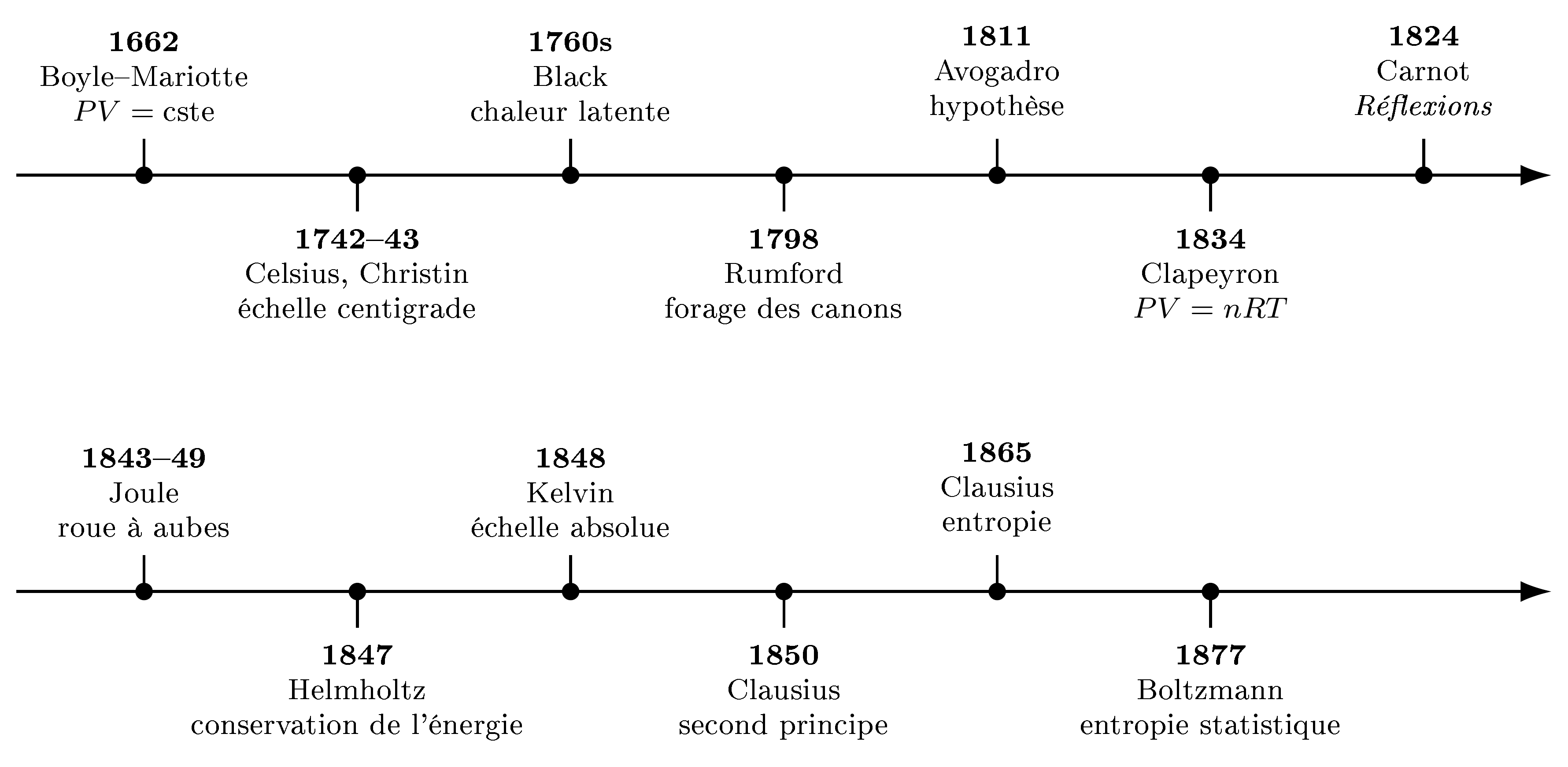
The previous lesson presented the architecture of modern thermodynamics from the outset. To make it intelligible, we formulated it in the modern language of energy, heat, reversibility, and entropy. The presentation was therefore deliberately anachronistic: Carnot, Joule, Kelvin, and Clausius did not possess the same concepts or theoretical framework; they discovered them.
We shall now revisit this history in its proper order. This time, the aim is to understand the experimental and conceptual problems that made it necessary to formulate the fundamental laws of thermodynamics. This journey will take us to the synthesis achieved mainly by Clausius and Kelvin from the 1850s onward, of which we shall give only the broad outlines here.
1. The beginnings
1.1. Hero's aeolipile
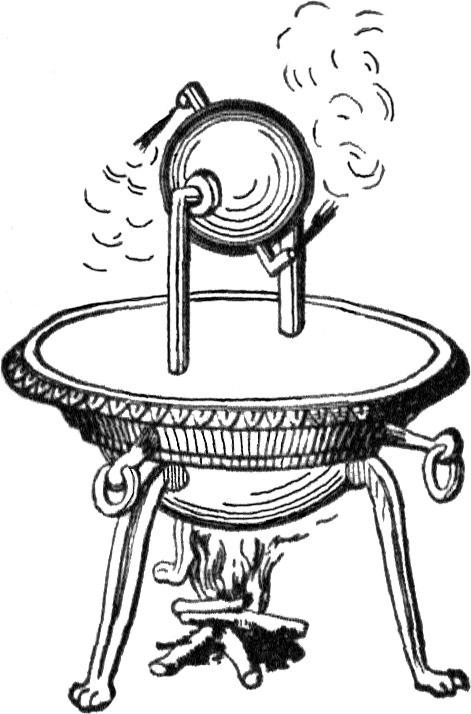
In the first century CE, Hero of Alexandria described the aeolipile: a hollow sphere supplied with steam by a small boiler that could rotate about an axis. Steam escaped through two bent tubes pointing in opposite directions and set the sphere in rotation; see Fig. 1. It is one of the earliest documented steam devices and a rudimentary form of reaction turbine: heat transfer is used to generate mechanical work through a change of state and the pressurization of the fluid. There is no evidence, however, that it was used to perform useful mechanical work.
Note, however, that it does not operate in a cycle: after some time, all the water has evaporated and the machine stops. Closing the cycle would require condensing the discharged steam, which requires a cold reservoir, and feeding it back into the device.
Hero of Alexandria invented other hydraulic and pneumatic devices operating through temperature and pressure; see, for example, [1]. Yet these devices never led to industrial development comparable to that of the XIXth century. One reason often given is that the metallurgy of the time could not produce sealed vessels capable of withstanding high pressures. Moreover, the theoretical tools were entirely lacking. In particular, the fundamental distinction between temperature (which characterizes the state of thermal equilibrium) and heat (energy transferred) had not been formalized.
1.2. Thermometry
Before reasoning about heat was possible, one first had to know how to measure hot and cold. Yet no reliable thermometer existed before the XVIIth century. Around 1600, Galileo built a thermoscope based on the varying height of a liquid column, but its design actually made it sensitive simultaneously to changes in temperature and atmospheric pressure, rather than to temperature alone.
By isolating the thermometric fluid from the atmosphere, the influence of external pressure is eliminated: the height of the column then depends only on the thermal expansion of the liquid. This breakthrough occurred during the same century with the invention of the liquid-in-glass thermometer (using alcohol and later mercury).
Between 1710 and 1720, Fahrenheit improved mercury purification and the uniformity of glass tubes[2], while also proposing a scale that remains in use in the United States today. In 1742, Celsius proposed a new scale based on two reproducible fixed points. Based on the phase changes of water at normal atmospheric pressure, corresponds to the melting point of ice and to the boiling point of water1.
In 1848, Thomson proposed the principle of an initial absolute scale independent of the properties of any particular thermometric substance. This first construction was logarithmic; it would be reformulated in subsequent years to yield the present Kelvin scale.
Consequently, a temperature difference has the same numerical value in kelvins and degrees Celsius, a convenient property for many numerical calculations. Zero Celsius is , while absolute zero is . The relation between Fahrenheit and Celsius is also affine, but this time with a multiplicative coefficient other than 1:
The problem of measuring temperature was thus resolved. It should be noted, however, that at the time the terms heat, fire, and temperature were used almost interchangeably. Two foundational experiments forced these concepts apart.
1.3. Heat capacity
In the 1760s, the Scottish chemist Joseph Black observed that equal masses of different substances, heated by the same source for the same length of time, did not reach the same temperature: each body has a certain capacity to absorb “fire” (what we would now call heat), which we shall call its thermal or heat capacity; see Fig. 2.
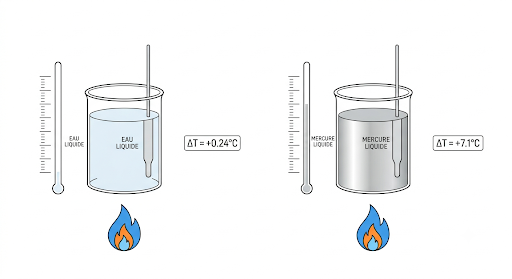
The quantity of heat received and the resulting temperature change are therefore distinct quantities, related by a coefficient specific to each material. In modern notation, we have:
where is the quantity of heat received by the body, in joules (J), is its mass in kilograms (kg), and is the resulting temperature change, in kelvins (K), or equivalently in degrees Celsius, since it is a temperature difference.
The letter denotes the material's specific heat capacity, or, in older terminology, its specific heat. It is expressed in joules per kilogram per kelvin (J kg K), and represents the quantity of heat that must be supplied to one kilogram of matter to raise its temperature by one kelvin.
Remark: this definition depends on the external conditions. We shall see again, for example, that there is a at constant external pressure, which is generally not equal to at constant volume, and so forth.
1.4. Latent heat
Black then identified a second phenomenon: the latent heat of a change of state. He showed that melting ice requires a substantial input of heat, whose value he estimated through calorimetric experiments. More importantly, he observed that for a mixture of ice and water in equilibrium at atmospheric pressure, the temperature remains close to as long as both phases coexist. Unlike the previous case, the heat supplied therefore causes no increase in temperature, but merely transforms the ice progressively into liquid water.
In Black's terminology, this heat is said to be latent because it is, as it were, hidden: its presence does not manifest itself through a rise in temperature2. For a pure substance (that is, one consisting of a single chemical species) undergoing a phase change at constant pressure, we now write
where denotes the heat received by the body, the mass that changes phase, and the specific latent heat associated with the transformation from phase 1 to phase 2. It is expressed in joules per kilogram ().
In the case of melting ice, this transformation is endothermic: the body receives heat. Black showed experimentally that the reverse transformation is exothermic and releases all of this heat. Thus:
With the convention adopted here, means that the body releases heat to its surroundings. We shall give a more precise thermodynamic definition of latent heat in Lesson 9. We shall prove the preceding relation and specify the conditions under which it is valid.
Black's work helped establish quantitative calorimetry, that is, the measurement of quantities of heat. At the time, however, a fundamental question remained open: what is heat?
Before addressing this controversy, we must present another line of research conducted in parallel on the properties of gases. By establishing quantitative relations between pressure, volume, and temperature, this work provided the first examples of thermodynamic laws relating the macroscopic variables of a system. It also introduced the idea of an absolute temperature and supplied Carnot, Clapeyron, and Clausius with the main model system for their later work.
2. The ideal gas law
A series of experiments beginning in the XVIIth century sought to determine how the pressure, volume, and temperature of a given quantity of gas vary with one another.
In 1662, Boyle (and independently Mariotte in 1676) established that, at fixed temperature, the product of pressure and volume for a given quantity of gas is constant:
Around 1700, Guillaume Amontons studied air at fixed volume and showed that its pressure increases steadily with temperature. Extrapolating this relation to low temperatures, he observed that the pressure would vanish at a finite temperature, which he estimated roughly as : this was the first experimental appearance of the idea of an absolute minimum temperature. Then, around 1800 (Charles around 1787, in unpublished work; Gay-Lussac in 1802), it was established that, at fixed pressure, the volume of a gas increases linearly with temperature3:
The same extrapolation applies: the volume would vanish at a finite temperature, this time estimated at around . More accurate measurements in the XIXth century (notably those of Regnault) would bring this value closer to . The idea of absolute zero thus preceded its theoretical justification by Kelvin and Clausius by more than a century.
Adding Avogadro's hypothesis (1811), according to which equal volumes of different gases under the same conditions contain the same number of molecules, provides all the ingredients needed to combine these laws into one. In 1834, Clapeyron was the first to write the ideal gas equation of state in unified form:
where is the number of moles and the ideal gas constant[5]. (The same remark about the temperature scale applies; see the preceding footnote.)
This equation says nothing in itself about the nature of heat: it relates three state variables of a single system. Its historical role, however, is twofold. First, the gas became the preferred system of study: simple, reproducible, and described by a universal equation of state, it served as the theoretical working fluid for Carnot, Clapeyron, and later Clausius in their reasoning about machines. Second, the linear relation between volume (or pressure) and temperature, common to all sufficiently dilute gases, suggests that in the ideal-gas limit there exists a temperature scale independent of the gas used. This is an initial indication of the existence of an absolute temperature scale and absolute zero.
3. The nature of heat
To understand why this question could divide physicists so deeply, we must place ourselves in the context of the period. At the end of the XVIIIth century, the modern concept of energy did not yet exist. Several related quantities were studied in mechanics, electricity, and calorimetry, but they had not yet been brought together as the single fundamental quantity that runs through and structures all of modern physics. Yet the concept of heat is in fact intimately linked to energy and its conservation, as we shall now explain.
3.1. Two schools of thought
At the time, two very different conceptions of the nature of heat were in conflict.
The first, which we shall call the mechanistic or kinetic view, held that heat is nothing more than the agitation of the smallest parts of matter. The hotter a body, the more agitated its constituents. A flow of heat is merely the step-by-step transmission of this motion through collisions between particles. This idea is an old one: it can be found in Francis Bacon, who wrote as early as 1620 that heat is a form of motion, and in Descartes.
The second view, which came to dominate at the time, was the caloric theory. According to this theory, heat is a material substance, a “subtle and weightless” fluid called caloric. This fluid fills bodies and flows spontaneously from hot to cold; its particles repel one another, which successfully accounts for the expansion of heated bodies that had also been established experimentally. In his 1789 Elementary Treatise of Chemistry, Lavoisier went so far as to include caloric in his list of elements alongside oxygen and hydrogen.
It is important to understand that caloric theory was not merely a crude error: it was a fruitful theory that accounted for many facts within a coherent framework. Thermal expansion was explained by the mutual repulsion of caloric particles, latent heat was interpreted as caloric “bound” to matter, and calorimetry was understood as the bookkeeping of a quantity of caloric fluid passing from one body to another.
The most important point, however, was that caloric appeared to be conserved: in all purely calorimetric experiments (mixtures, changes of state, reactions), the quantity of heat released by one body was recovered in the others, exactly as a fluid pours from one vessel into another. This conservation was the strongest argument in favor of the fluid. In modern thermodynamic terms, it is even correct: in the absence of mechanical work, accounting for heat flows is indistinguishable from the energy balance.
What experiments of the period still lacked was the observation that work can be converted into heat, which would bring down caloric theory. This is what Rumford and Davy observed experimentally.
3.2. The experiments of Rumford and Davy
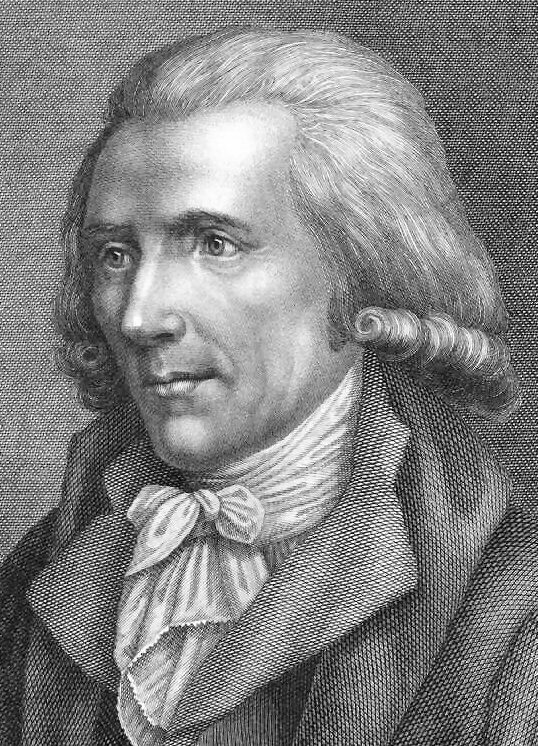
At the very end of the XVIIIth century, Benjamin Thompson, Count Rumford, supervised the boring of cannons in Munich. He observed that friction between the tool and the metal released a considerable amount of heat and, above all, an apparently inexhaustible amount: as long as the boring continued, heat continued to be produced. Yet if heat were a conserved fluid contained in the metal of the drill and cannon, it should eventually be exhausted. In 1798, Rumford concluded that heat could not be a material substance, but had to be related to motion. Davy made the same argument in 1799 by melting two pieces of ice through friction against one another: motion produces heat.
These results did not suffice to overturn caloric theory immediately, because proponents of the fluid raised objections. They nevertheless constituted the first objection to which the theory could respond only at the cost of additional, unnatural hypotheses. If a thermal effect can be sustained for as long as mechanical work is supplied, then heat cannot come from a finite reserve contained in the metal. The experiments instead suggest that mechanical work can cause an energy transfer producing the same effects as simple heating.
4. The equivalence of heat and work
Following Rumford's work, a natural question arose: what precise relation exists between mechanical work and heat? The most decisive experiments on this question were conducted by James Prescott Joule, a physicist and brewer in Manchester.
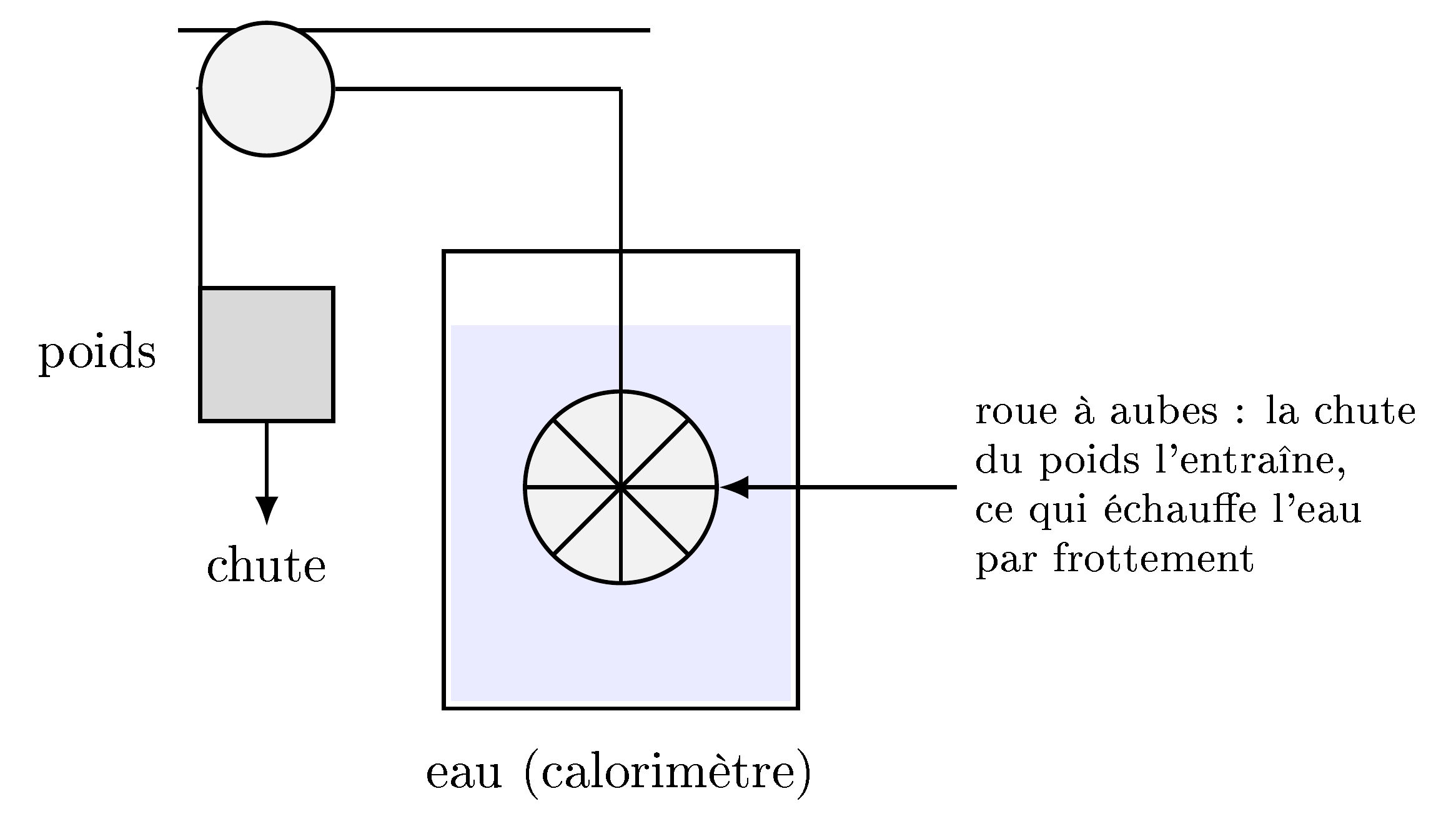
Between 1843 and 1849, Joule studied the production of thermal effects by various means, including mechanical friction and electrical dissipation. His most famous experiment is the paddle-wheel experiment shown in Fig. 4. A falling mass drives a wheel immersed in the water of a calorimeter. The formula makes it possible to evaluate the mechanical work transmitted to the apparatus. This work is dissipated by viscous friction in the liquid, whose temperature then rises slightly.
By comparing the amount of work with the rise in temperature, Joule determined the mechanical equivalent of heat with increasing precision. His experiments showed that the same quantity of work, when fully dissipated, always produces the same thermal effect, regardless of the process used. Work and heat thus appeared to be two modes of transfer of the same quantity: energy.
At the time, quantities of heat were notably measured in calories. Historically, one calorie corresponds to the quantity of heat required to raise the temperature of one gram of water by one degree Celsius4. Joule established the value of the mechanical work equivalent to this quantity of heat. In the units of the International System, the unit of energy, the joule, is appropriately named after him, and
With Joule, it was now established that heat and work are not two substances or two independent physical quantities, but two modes of transfer of a single quantity: energy, which is conserved.
This is formalized by the first law of thermodynamics, which we shall study in Lesson 4 and which can be written, in essence, as
The change in a system's energy equals the energy it receives as heat () and work (). Heat and work are therefore not quantities contained in the system, but modes of transfer of energy across its boundary. In the absence of such transfers, the system's energy is conserved:
Through the work of Mayer, Joule, Helmholtz, Clausius, and Rankine, the experimental results discussed above led, around the middle of the XIXth century, to the general statement of the conservation of energy: “the sum of all the energies of the universe is invariable” (Rankine, 1853). For further details, see reference [saslow2020].
5. The final synthesis
By the middle of the XIXth century, the principal elements of modern thermodynamics were in place, but they still came from separate lines of work.
On the one hand, Joule's experiments had established the quantitative equivalence between mechanical work and thermal effects. They gradually led to the idea that a single quantity, energy, can be transferred or transformed into different forms while remaining conserved.
On the other hand, Carnot had shown as early as 1824 that between two reservoirs at given temperatures, no heat engine can be more efficient than a reversible engine, and that all reversible engines have the same performance regardless of their construction and the fluid they use (see Lesson 1). This result is remarkable, but Carnot had obtained it within the framework of caloric theory, before the equivalence of heat and work was known.
Beginning in the 1850s, the work of Clausius and Kelvin synthesized these two advances. They reformulated Carnot's conclusions within the new energetic framework made possible by Joule's experiments. A heat engine receives energy from the hot reservoir, converts part of it into mechanical work, and rejects the rest to a colder reservoir. Carnot's reasoning about reversible engines and their maximum efficiency remained valid, but its caloric-based interpretation was abandoned.
This synthesis brought to light two distinct fundamental laws.
The first expresses the conservation of energy and the equivalence of heat and work: it is the first law of thermodynamics, already discussed above.
The second states that conservation of energy is not sufficient to determine which transformations are physically possible. It imposes an additional constraint on the direction of heat transfer and sets the maximum performance of machines: this is the second law of thermodynamics. In developing this idea, Clausius introduced a new quantity, entropy, which made it possible to formulate the irreversibility of transformations mathematically.
Modern thermodynamics thus emerged from the union of two previously separate ideas: the first law establishes the energy balance; the second adds a constraint on the direction of possible transformations.
We shall not develop their content further here. All the lessons that follow will be devoted to the precise construction of these two laws.
The story then continues with the statistical formulation of thermodynamics, which relates the macroscopic properties of systems to their microscopic constituents. This approach, initiated by Boltzmann and Gibbs, makes it possible to understand the microscopic origin of entropy. It will be addressed only in the second part of this book.
More recent axiomatic formulations of thermodynamics have been developed. These approaches rely on a much more detailed set of assumptions. We shall discuss them in the more advanced second part of this book.