1. Trying to understand thermodynamics
This introduction is deliberately dense. Its purpose is not so much to teach as to provide, from the outset, an overview of what thermodynamics is. It also serves more as a summary than as a preview of what we will study in detail throughout the course. Readers who find this introduction difficult on first reading should not be concerned: rereading it after working through the rest of the course is strongly recommended. The goal is not merely to know how to do thermodynamics, which many students manage to do; the goal is to understand the nature of the theory, and that is considerably more difficult.
Thermodynamics shares with classical mechanics the ambition of imposing a unified formal framework on the evolution of measurable physical quantities. In mechanics, these quantities are positions and velocities, which are directly accessible to observation. Thermodynamics studies macroscopic systems composed of a very large number of particles, and there is no question of describing positions and velocities precisely. On the contrary, even everyday experience teaches us that the relevant quantities at this scale are pressure, temperature, volume, energy, concentrations, and so forth. These quantities may appear equally familiar, but they have a different epistemic status. Some of them are quantities aggregated over the entire system (e.g., total energy and concentrations), whereas others, such as temperature and pressure, are emergent. Thermodynamics formalizes the relationships among these macroscopic quantities. The resulting equations are meaningful only at this scale.
This immediately raises a central question that thermodynamics cannot itself answer but must presuppose: why are a small number of parameters sufficient to describe the evolution of such a complex system? Why do we not need to know the position and velocity of every molecule in order to predict the behavior of a gas? This remarkable fact, the macroscopic forgetting of the microscopic, is the founding postulate of the theory. It is supported by two centuries of experiments, but its deeper explanation belongs to statistical physics and remains a partly open question.
The situation would still be fairly simple if we merely accepted this. Experiments, however, reveal a new phenomenon in these systems: some transformations occur spontaneously in one direction and are impossible in the other. For example, heat flows spontaneously from hot to cold, and never the reverse. This asymmetry observed in physical phenomena therefore requires the theory to distinguish rigorously between reversible transformations and irreversible transformations.
This requires the introduction of a new quantity with no counterpart in classical mechanics: entropy, one of the most difficult physical quantities to grasp. It is a scalar quantity associated with the macroscopic state of the system, and it cannot decrease during the spontaneous evolution of an isolated system. Thermodynamics thus does not provide a differential equation for time evolution in the sense of mechanics. Instead, it establishes an entropy-based balance that constrains the direction of possible transformations and quantifies their degree of irreversibility. This is the second law of thermodynamics.
The possibility of forgetting microscopic details, combined with the existence of entropy, is responsible for the remarkable universality of thermodynamic phenomena. An ideal gas, a chemical equilibrium, and a stellar equilibrium all obey the same structural laws. Ultimately, these two phenomena are connected to a probabilistic description of the microscopic state of the system. This is the subject of statistical physics, which sheds light on the foundations of thermodynamic theory. This discussion will, however, be deferred to the more advanced second part of the book.
The remainder of the lesson examines in greater detail the historical and conceptual progression that has taken us, over two centuries, from steam engines to black-hole entropy. Along the way, we use bold type to indicate the vocabulary characteristic of thermodynamics, which will gradually be defined rigorously throughout the rest of the book.
2. A theory of the conversion of heat into work
Thermodynamics emerged in the early nineteenth century from the study of heat engines, particularly the steam engine. It arose from the need to understand and quantify the conversion of the energy released by combustion into mechanical work. We will use the term heat below, but it should be kept in mind that this concept was still very poorly understood in Carnot's time. Its modern definition is that heat is a mode of transfer of internal energy between two systems.
The steam engine itself was older: devices that used steam to pump or move fluids appeared in Europe as early as the seventeenth century. But it was Watt who, beginning in 1769, turned it into a truly industrial machine. Its efficiency (see below) was still rather low, however. A question then became urgent. Could one do better, and if so, how?
The issue is the following. Burning coal releases energy, but this energy does not immediately turn a wheel or a drive shaft. To do so, it must be converted into mechanical work. This is precisely what heat engines do in general; modern examples include thermal power plants (coal-fired, natural-gas-fired, or nuclear) and gasoline engines. Efficiency is then calculated as the ratio of the mechanical energy produced to the amount of energy received, and the aim is to maximize it.
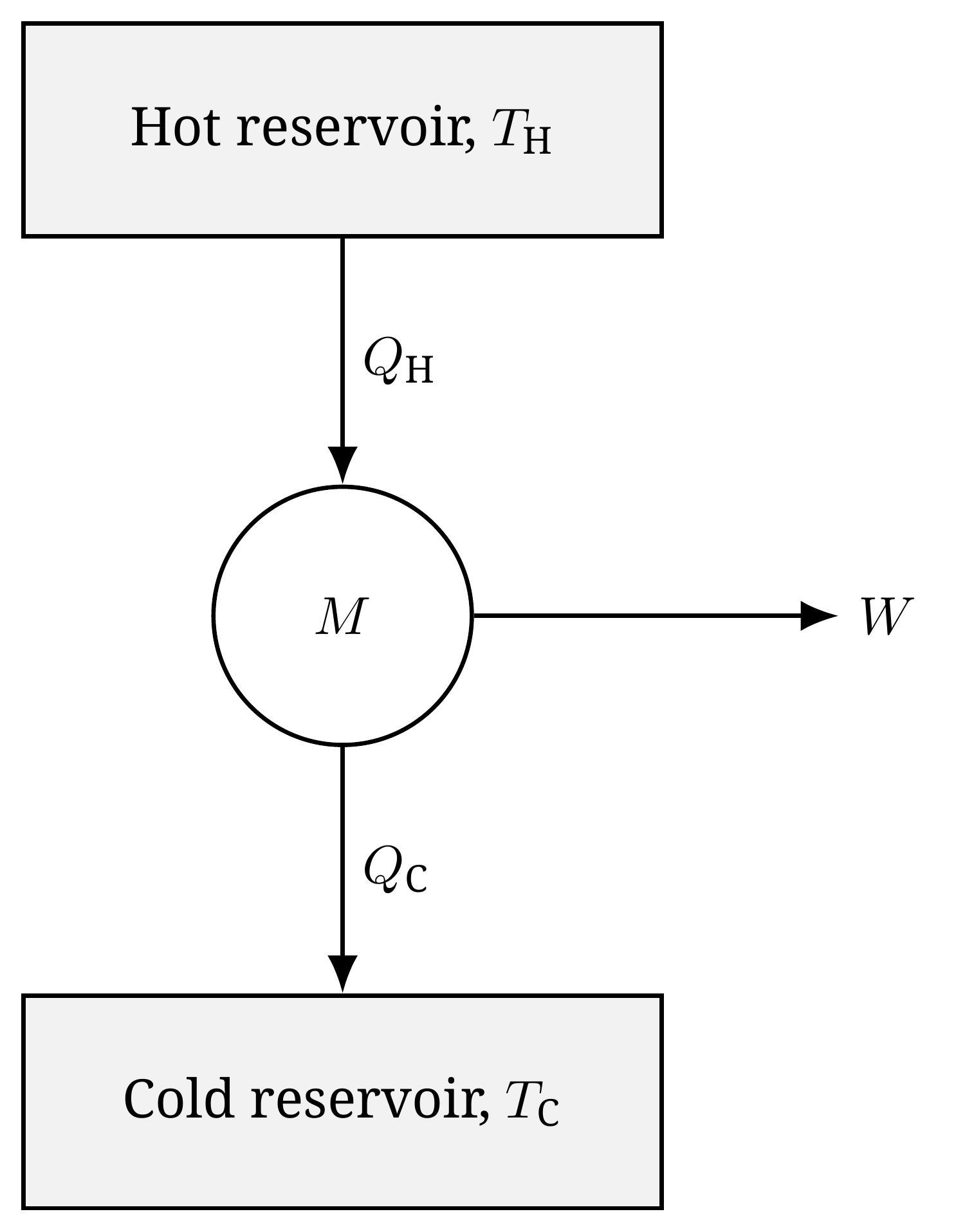
Let us clarify what is meant by a heat engine. One can devise a device that converts received heat into work in a single operation: a gas placed in contact with a high-temperature reservoir, called the hot reservoir, expands and pushes a piston, thereby converting all the heat received into work. But this device will operate only once unless the piston is returned to its initial position. What we call an engine is a machine designed to operate indefinitely, in a cycle. It must periodically return to its initial state (see Fig. 1).
It is precisely this quest for maximum efficiency that will lead to a profound discovery: some limits are not technical but fundamental.
3. A theory based on the second law
Consider a period of extreme heat. A modern air conditioner receives electrical energy and uses it to cool the air in a room by extracting heat from it and rejecting that heat outdoors. Would it not be far more advantageous simply to extract the heat from the room and convert it entirely into mechanical work? The room would be cooled while useful energy was produced, effectively for free.
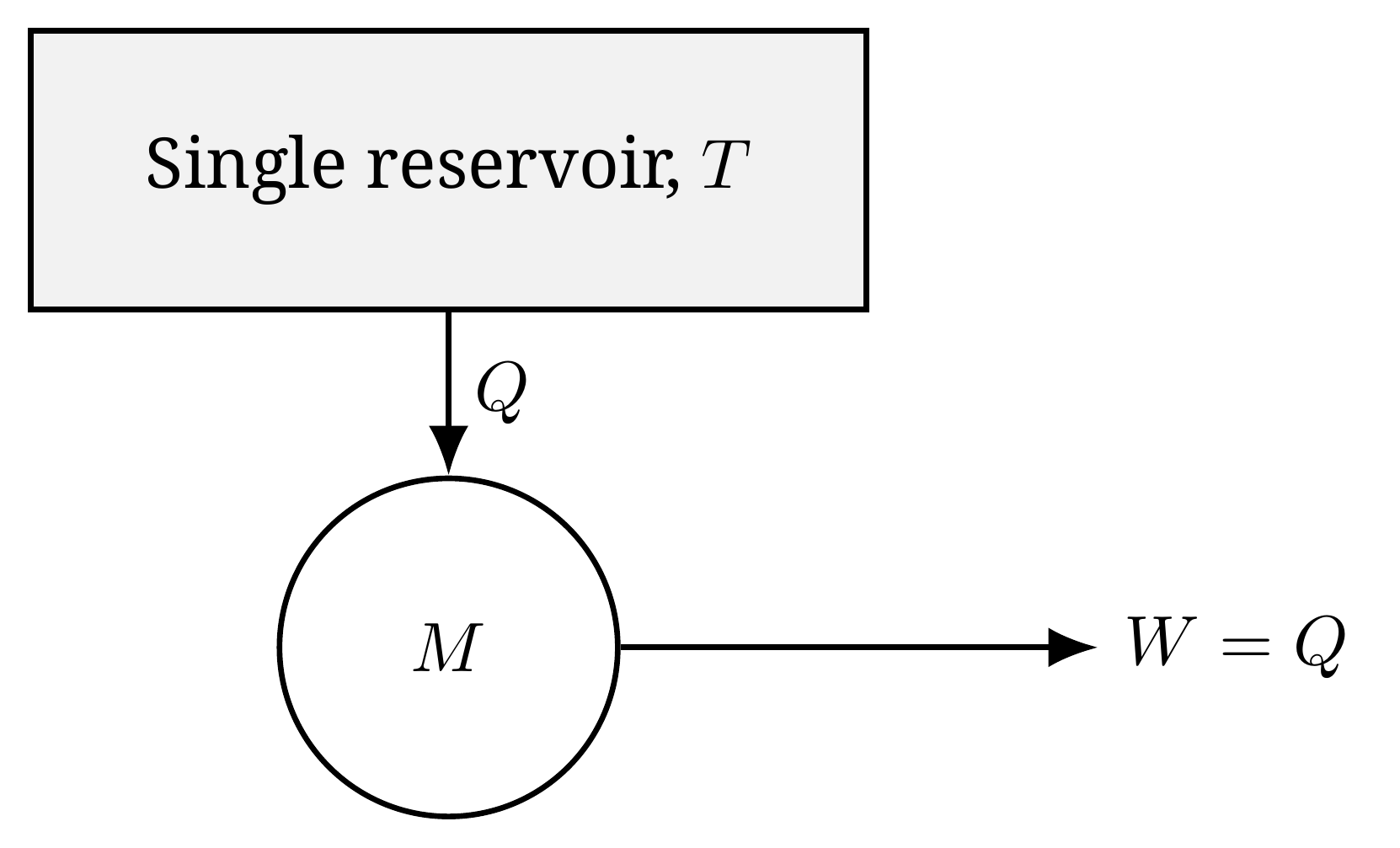
Achieving this would mean building a cyclic heat engine that converts all the heat it receives into work, drawing heat from the room until it reaches absolute zero. If such a machine is not sold at the shop down the street, it is not because no one has managed to build one: it is because it is impossible (see Fig. 2).
This powerful result was established gradually over the course of the nineteenth century. The precise history is somewhat complex, and we will examine it fully. At the risk of being slightly inaccurate for the moment, let us state the following points:
- In 1824, Carnot showed that, in order to operate, a heat engine must necessarily reject part of the heat received from the hot reservoir to a colder environment — what is called a cold reservoir. An engine converts a fraction of the heat flow from hot to cold into mechanical work, never all of it. He also established (through a rather magnificent argument) that the efficiency of any heat engine is bounded above by a theoretical limit that depends only on the temperatures of the two reservoirs, not on the technical details of the engine or even on the fluid circulating through it. This is the Carnot efficiency. He demonstrated its existence without being able to give its exact expression because a rigorous definition of temperature was lacking.
- Around 1848, Kelvin supplied precisely what was missing by defining an absolute temperature scale, the one still used today. This determined the exact expression for the Carnot efficiency. In doing so, he made explicit what Carnot had in fact already demonstrated: it is impossible to convert heat entirely into work during a cycle. This is known as the Kelvin statement of the second law. It is what makes it impossible to build the perfect air conditioner described above.
- Finally, between 1850 and 1865, Clausius understood that this maximum efficiency requires the existence of a new quantity, which he named entropy. He understood that this quantity measures the irreversibility of physical processes: it cannot decrease during the spontaneous evolution of an isolated system. This is the second law in its most general formulation, which is still used today.
The lesson for the engineers of the time was radical. Increasing efficiency was not merely a matter of reducing friction or heat losses; it also required action on two entirely different levers: designing machines whose operation comes as close as possible to the ideal Carnot cycle, and increasing the temperature difference between the hot and cold reservoirs1. This conclusion, it must be admitted, was anything but obvious and perfectly illustrates the predictive power of thermodynamics.
In class, I often give the following example because it makes a strong impression: through bad luck, you find yourself on a raft in the middle of the ocean, with no engine, sail, or oars. Can you move forward? Yes, by swimming... or perhaps you have on your raft the tools needed to build a mechanical system, and you can construct it so that it exploits the small temperature difference between the air above you and the generally colder water beneath you. You have thus built an engine that runs without fuel. The main message, which often comes as a surprise, is that a heat engine does not need fuel to operate. Or rather, the temperature gradient is the fuel.
This example is not so fanciful, in fact, because OTEC plants (Ocean Thermal Energy Conversion) are industrial installations that exploit the temperature difference between surface ocean water and deep ocean water to extract mechanical work.
4. A universal theory
The original question has therefore received a definitive answer. But the discovery of entropy and the second law showed the physicists of the time that the theory developed to describe heat engines had a much broader scope and belonged far more clearly to fundamental physics than to engineering.
Following Carnot and Clausius, one question thus became central: what is entropy, and why does it exist? In the second part of the book, we will see that statistical physics provides a profound answer by interpreting the state of a system probabilistically: a single macroscopic state can correspond to a multitude of different microscopic states. And it is precisely because these foundations are probabilistic — and because probabilities are universal — that thermodynamic theory acquires such an extraordinarily broad range of applications.
Beyond engines, for example, thermodynamics was found to govern phase changes as well: it determines the exact conditions under which water boils or ice melts. It also describes chemical equilibria, determining the spontaneous direction of reactions and the energy exchanges that accompany them. It made it possible to calculate the power radiated by any body in thermal equilibrium, known as black-body radiation, whose microscopic explanation by Planck gave rise to quantum mechanics. More surprisingly still, Bekenstein and Hawking showed in 1973—1974 that black holes are themselves thermodynamic objects, endowed with well-defined temperatures and entropies. This result continues to guide research in quantum gravity.
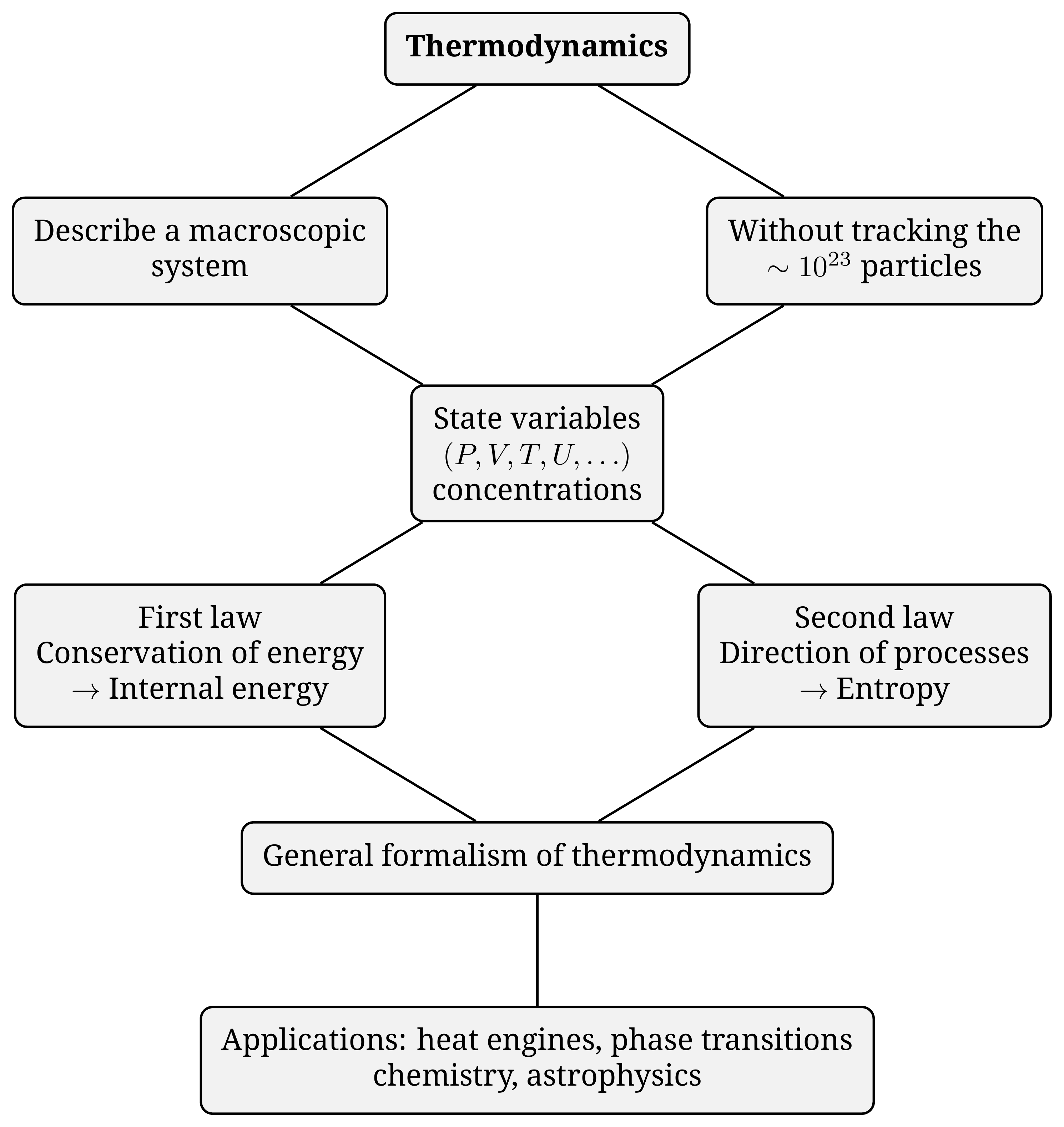
This diversity of applications might give the impression of a proliferation of formulas. In reality, the architecture of the theory is relatively simple: a small number of concepts — system, equilibrium, energy, entropy — and a few general principles are sufficient to organize the whole (see Fig. 3). The remainder of this first part is devoted precisely to demonstrating this explicitly.
5. Course outline
Many introductory thermodynamics textbooks devote considerable attention to the physics of the ideal gas. This approach certainly has the advantage of allowing a gradual introduction to the theory, but it risks leading students to believe that thermodynamics is limited to the study of cylinders, pistons, and the ideal-gas equation .
We hope that the preceding discussion has provided enough information to make clear that reducing thermodynamics to ideal gases would be a major misunderstanding of the nature of the theory. We will therefore not favor this gradual approach, but will instead address the most structural aspects of the theory directly: its specialized vocabulary, its kinematics, so to speak (i.e. state variables, state space, state functions, and transformations), its differential geometry, and finally the concept of entropy, one of the most subtle quantities in all of physics.
We will nevertheless cover the ideal gas: it will serve as a recurring example to illustrate each new concept. But it will remain what it is: a convenient special case, not the heart of the theory.
The course is organized as follows:
- Lesson 2: Historical Perspective. A look back at the forgotten caloric theory and the transition to the modern formalism (this lesson may be skipped on a first reading).
- Lesson 3: Fundamental Concepts. Rigorous definitions of the basic vocabulary (system, walls, constraints, equilibrium, state variables, intensivity and extensivity, state space, and thermodynamic transformations).
- Lesson 4: The First Law. Microscopic and macroscopic construction of the internal energy . Definition of work and heat transfers; exact and inexact differential forms.
- Lesson 5: Application of the First Law to the Ideal Gas. Explicit calculations for elementary ideal-gas processes. Adiabatic index and Laplace's law.
- Lesson 6: Reversibility, Irreversibility, Entropy. Operational introduction to the second law as the prohibition of spontaneous heat transfer from cold to hot; Carnot-Clausius construction of entropy through the maximum efficiency of heat engines, and finally a quantitative formulation of the second law in terms of entropy.
- Lesson 7: The Fundamental Relation. Combining the two laws yields a fundamental equation, generalized to open systems, which constrains the differential geometry of the equilibrium state space. Gibbs-Duhem relation, ideal-gas entropy; equilibrium and stationarity of entropy.
- Lesson 8: Calorimetric and Thermoelastic Coefficients. Connect heat, expansion, and compressibility to measurable properties and stability.
- Lesson 9: Thermodynamic Potentials. Choose the potential suited to the constraints to determine equilibrium and available work.
- Lesson 10: Phase Transitions. Phase diagrams, instabilities, and the van der Waals gas.
- Lesson 11: Heat Engines and Refrigeration Machines. Study the steam engine and refrigeration cycles.
- Lesson 12: Thermodynamics of Radiation. Describe thermal radiation and the properties of a black body.