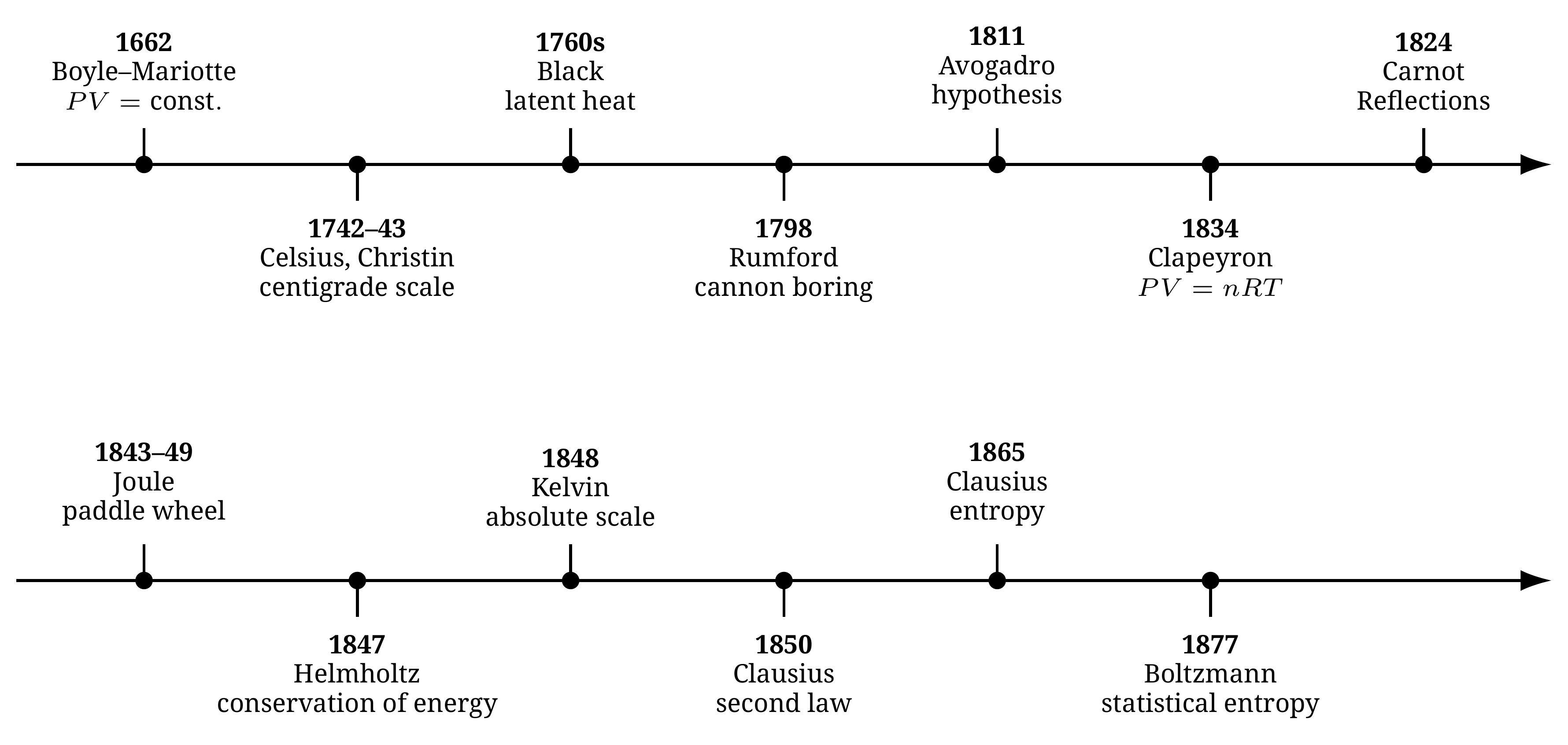
The previous lesson presented the architecture of thermodynamics in its modern language, in which the concepts of energy, heat, and temperature, in particular, are well understood. But Carnot, Joule, Kelvin, and Clausius had neither the same concepts nor the same theoretical framework: they discovered them.
We will now retrace the major stages of this long history. The aim of this lesson is to understand the experimental and conceptual problems that made the formulation of the fundamental laws of thermodynamics both possible and necessary.
1. The beginnings
1.1. Hero's aeolipile
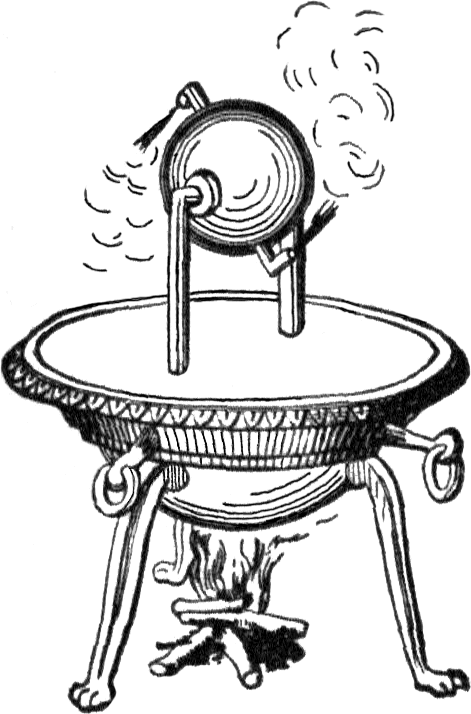
In the first century CE, Hero of Alexandria described the aeolipile: a hollow sphere, supplied with steam by a small boiler, free to rotate about an axis. The steam escapes through two bent tubes pointing in opposite directions and sets the sphere spinning; see Fig. 1. It is one of the earliest documented steam devices and a rudimentary form of reaction turbine: heat transfer is used to generate mechanical work through the change of state and pressurization of the steam. There is no evidence, however, that it was ever used to perform useful mechanical work.
Note also that this machine does not operate in a closed cycle: after a while, all the water has evaporated and the machine stops. Despite its disarming simplicity, the aeolipile thus illustrates the role of the cold reservoir in heat engines. The exhausted steam cools and condenses in the atmosphere, which already plays the role of the cold reservoir: the cycle is simply open – it closes outside the machine. To close the cycle within the machine itself, one would have to recondense the discharged steam in contact with a cold reservoir, then feed the resulting liquid water back into the device. One would then obtain a closed-cycle heat engine, in the sense made precise in the previous lesson.
Hero of Alexandria invented other hydraulic and pneumatic devices driven by temperature and pressure; see, for example, [1]. Yet these devices never led to industrial development comparable to that of the nineteenth century. One reason often given is that the metallurgy of the time could not produce sealed vessels capable of withstanding high pressures. Moreover, the theoretical tools were entirely lacking. In particular, the fundamental distinction between temperature (which characterizes the state of thermal equilibrium) and heat (energy transferred) had not been formalized. More generally, mathematical tools that seem elementary to us today, such as the notion of a function or differential calculus, would not be developed until much later.
1.2. Thermometry
Let us move forward 1500 years. Before anyone could reason about heat, one first had to be able to measure hot and cold. Yet no reliable thermometer existed before the seventeenth century. Around 1600, Galileo built a thermoscope based on the varying height of a liquid column, but by design it was in fact sensitive to changes in both temperature and atmospheric pressure, not to temperature alone.
Isolating the thermometric fluid from the atmosphere eliminates the influence of external pressure: the height of the column then depends only on the thermal expansion of the liquid. This innovation came during the same century with the invention of the liquid-in-glass thermometer (using alcohol, and later mercury).
Between 1710 and 1720, Fahrenheit improved mercury purification and the uniformity of glass tubes[2], while also proposing a graduated scale that remains in use in the United States to this day. In 1742, Celsius proposed a new scale based on two reproducible fixed points. In this scale, anchored to the phase changes of water at normal atmospheric pressure, corresponds to the melting point of ice and to the boiling point of water1.
In 1848, Thomson proposed the principle of an absolute temperature scale, independent of the properties of any particular substance. This first construction, based on the work of Carnot that we will present further on, was logarithmic. It was reformulated in the following years, leading to the present scale, whose unit is the kelvin.
Consequently, a temperature difference has the same numerical value in kelvins and in degrees Celsius, a convenient property for many numerical calculations. Zero Celsius is , and absolute zero is . The relation between Fahrenheit and Celsius is affine, and the formula reads:
The problem of measuring temperature was thus solved. Note, however, that at the time the terms heat, fire, and temperature were used almost interchangeably. Two foundational experiments forced the distinction between heat and temperature.
1.3. Heat capacity
In the 1760s, the Scottish chemist Joseph Black observed that equal masses of different substances, heated by the same source for the same length of time, do not reach the same temperature: each body has a certain capacity to absorb “fire” (what we would now call heat), which we will call its thermal or heat capacity; see Fig. 2.
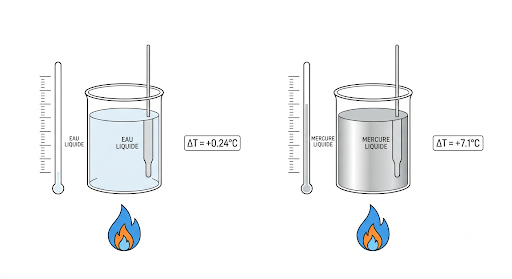
The quantity of heat received and the resulting temperature change are therefore two distinct things, related by a coefficient specific to each material. In modern notation, we have:
where is the quantity of heat received by the body, in joules (J), is its mass in kilograms (kg), and is the resulting temperature change, in kelvins (K), or equivalently in degrees Celsius, since it is a temperature difference.
The letter denotes the material's specific heat capacity or, in older terminology, its specific heat. It is expressed in joules per kilogram per kelvin (J kg K), and represents the quantity of heat that must be supplied to one kilogram of matter to raise its temperature by one kelvin. Remark: this definition depends on the external conditions. We will see later in the formalism that there is, for example, a , the specific heat capacity at constant external pressure, a at constant volume, and so on. They are not equal in general.1.4. Latent heat
Black brought to light a second phenomenon: the latent heat of a change of state. He showed that melting ice requires a substantial input of heat, whose value he estimated through calorimetric experiments. In doing so, he observed (at constant atmospheric pressure) that while the ice is melting, that is, as long as ice and liquid water coexist, the temperature stays close to . The heat supplied thus produces no rise in temperature; it merely turns the ice, little by little, into liquid water.
In Black's terminology, this heat is said to be latent because it is, so to speak, hidden: its flow does not show up as a rise in temperature2. For a pure substance (that is, one consisting of a single chemical species) undergoing a phase change at constant pressure, we now write
where denotes the heat received by the body, the mass that changes phase, and the specific latent heat associated with the transformation from phase 1 to phase 2. It is expressed in joules per kilogram ().
In the case of melting ice, the transformation is endothermic: the ice must receive heat in order to melt. Black also showed that the reverse transformation is exothermic and releases all of this heat. We therefore have:
With the convention adopted here, means that the body receives heat from its surroundings, and means that the body releases heat to them. We will give a more precise thermodynamic definition of latent heat in Lesson 11, where we will prove the relation above and spell out the conditions under which it holds.
Black's work helped found quantitative calorimetry. At the time, however, a fundamental question remained open: what is heat?
2. The nature of heat
To understand why this question could divide the scientific world of the period so deeply, one must know that at the end of the eighteenth century, the modern concept of energy did not yet exist. Several related quantities were studied in mechanics, electricity, and calorimetry, but they had not yet been brought together as the single fundamental quantity that runs through and structures all of modern physics. Yet the concept of heat is in fact intimately linked to that of energy and its conservation, as we will now explain.
2.1. Two schools of thought
At the time, two very different conceptions of the nature of heat were in conflict.
The first, called mechanistic or kinetic, holds that heat is nothing more than the incessant agitation of the elementary constituents of matter. The hotter a body, the more its constituents move about. A flow of heat is then merely the transmission, step by step, of this motion through collisions between particles. This idea was the right one, and it is an old one: it can be found in Francis Bacon, who wrote as early as 1620 that heat is a form of motion, and also in Descartes.
The second conception, which nevertheless came to dominate at the time, is the caloric theory. According to this theory, heat is a material substance, a “subtle and weightless” fluid called caloric. This fluid fills bodies and flows spontaneously from hot to cold; its particles repel one another, which neatly accounts for the expansion of heated bodies, itself well established experimentally and the working principle of the thermometers of the day. In his Elementary Treatise of Chemistry of 1789, Lavoisier went so far as to include caloric in his list of elements, alongside oxygen and hydrogen.
It is important to understand that caloric theory was not merely a crude error: it was a fruitful theory, which accounted for many facts within a framework that seemed coherent. Thermal expansion was explained by the mutual repulsion of caloric particles, latent heat was interpreted as caloric “bound” to matter, and calorimetry was read as the bookkeeping of a quantity of caloric fluid passing from one body to another.
But the most important point was that caloric appeared to be conserved: in all purely calorimetric experiments (mixtures, changes of state, reactions), the quantity of heat released by one body is recovered in the others, exactly as a fluid pours from one vessel into another. This conservation was the strongest argument in favor of caloric. In modern thermodynamic terms, it is even correct: in the absence of mechanical work, the bookkeeping of heat flows is indistinguishable from the energy balance (cf. the first law in Lesson 4, in the case where the work vanishes, ).
What the experiments of the period still lacked, then, was the observation that work can be converted into heat – the observation needed to shake caloric theory. This is what Rumford and Davy observed at the turn of the century.
2.2. The experiments of Rumford and Davy
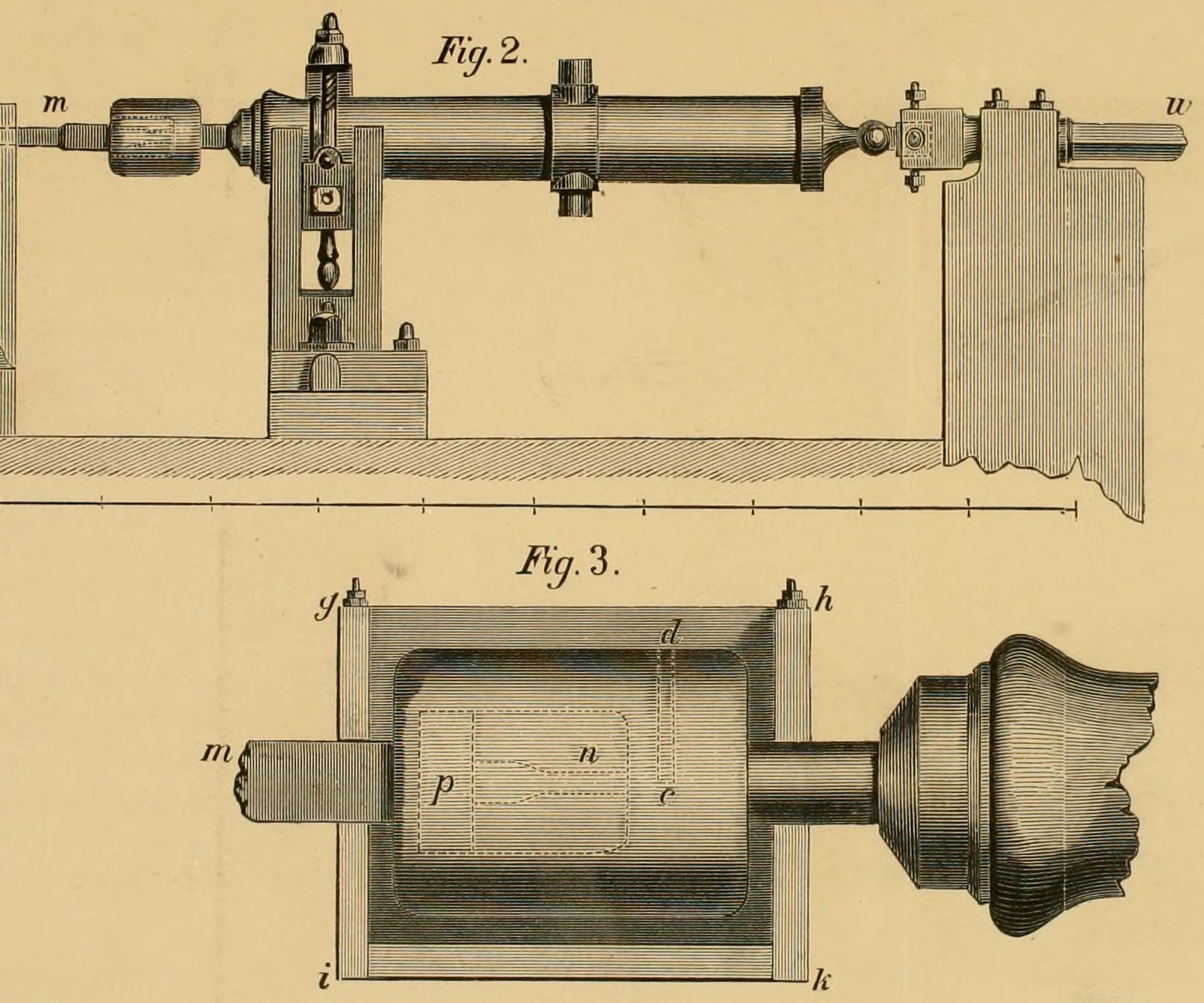
At the very end of the eighteenth century, Benjamin Thompson, Count Rumford, supervised the boring of cannons in Munich. He observed that the friction of the tool against the metal released a considerable amount of heat, and above all an apparently inexhaustible amount: as long as the boring went on, heat kept being produced. Yet if heat were a conserved fluid contained in the metal of the drill and the cannon, it should eventually run out. In 1798, Rumford concluded that heat cannot be a material substance, but must be related to motion. Davy made the same argument in 1799 by melting two pieces of ice through friction against one another: motion produces heat.
These results did not suffice to overturn caloric theory immediately, because its proponents found explanations for them, at the cost of additional and rather unnatural hypotheses. Still, it seems clear that if a thermal effect can be sustained for as long as mechanical work is supplied, then heat cannot come from a reserve contained in finite quantity in the metal.
3. Joule and the equivalence of heat and work
Following Rumford's work, a natural question arose: what precise relation exists between mechanical work and heat? At the time, heat had not yet been unified with energy and had its own unit, the calorie. A calorie is by definition the quantity of heat required to raise the temperature of one gram of water by one degree Celsius. But if mechanical work can supply the equivalent of this heat, there must be a relation between a calorie and a quantity of energy.
The most decisive experiments on this question were conducted by James Prescott Joule, a physicist and brewer in Manchester. Between 1843 and 1849, he studied the production of thermal effects by various means: mechanical friction and electrical dissipation, among others. His most famous experiment is the paddle-wheel experiment, shown in Fig. 4. A falling mass drives a wheel immersed in the water of a calorimeter. The formula gives the mechanical work transmitted to the apparatus. This mechanical work is dissipated by viscous friction in the liquid, whose temperature then rises slightly.
By comparing the amount of work with the rise in temperature, Joule determined the mechanical equivalent of heat with increasing precision. His experiments also showed that the same quantity of work, when fully dissipated, always produces the same thermal effect, whatever the process used (mechanical, electrical, etc.).
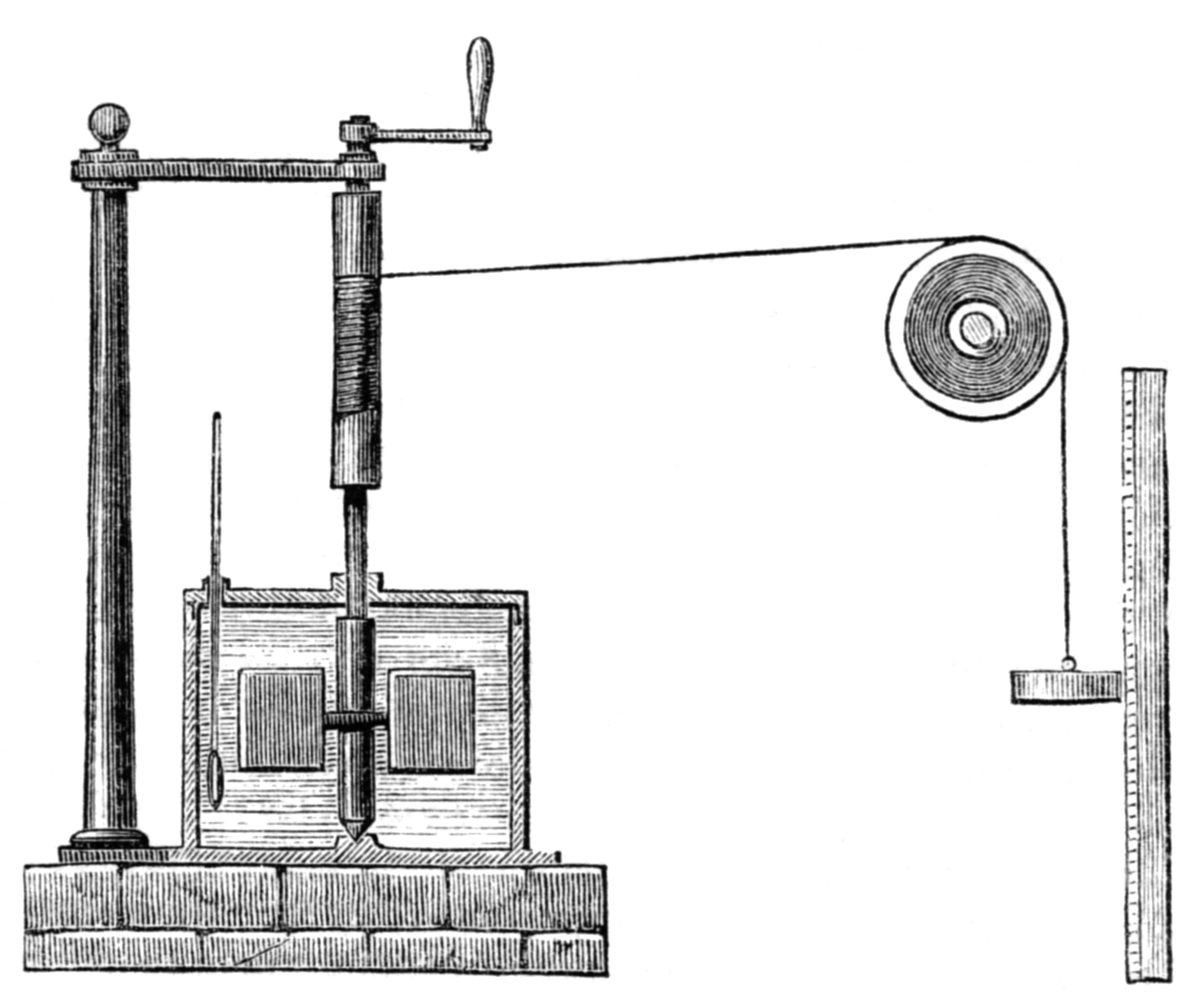
Joule thus established the value of the mechanical work equivalent to one calorie. Expressed in the units of the International System, whose unit of energy fittingly bears his name, this result reads3:
With Joule, it was now established that heat and work are nothing more than two modes of transfer of one and the same quantity: energy, which, for its part, is conserved. This is what the first law of thermodynamics would formalize; it reads, in essence:
that is, the change in a system's energy equals the energy it receives in the form of heat () and work (). Heat and work are therefore not quantities contained in the system, but modes of transfer of energy across its boundary. In the absence of such transfers, the system's energy is conserved:
The general idea of the conservation of energy emerged during the 1840s, partly independently, in the work of Mayer (as early as 1842), Joule, and Helmholtz (1847). Clausius gave its thermodynamic formulation in 1850, and Rankine summed it up in 1853: “the sum of all the energies of the universe is invariable.”
From the standpoint of the history of science, the establishment of the first law of thermodynamics is therefore inseparable from the discovery of the conservation of energy. For further details on the history of the first law, see reference [4]. For a more precise formulation, see Lesson 4.
4. The ideal gas law
Before turning to heat engines, let us step back to present another line of research, pursued in parallel with the debates on the nature of heat. From the seventeenth century onward, a series of experiments sought to determine how the pressure, volume, and temperature of a given quantity of gas vary with one another.
In 1662, Boyle (and independently Mariotte in 1676) established that, at fixed temperature, the product of pressure and volume for a given quantity of gas is constant:
Around 1700, Guillaume Amontons studied air at fixed volume and showed that its pressure increases steadily with temperature. Extrapolating this relation to low temperatures, he noticed that the pressure would vanish at a finite temperature, which he estimated roughly as : this was the first appearance, by experimental means, of the idea of an absolute minimum temperature. Then, around 1800 (Charles around 1787, in unpublished work; Gay-Lussac in 1802), it was established that, at fixed pressure, the volume of a gas increases linearly with temperature4:
The same extrapolation applies: the volume would vanish at a finite temperature, this time estimated at around . More accurate measurements in the nineteenth century (notably those of Regnault) would bring this value closer to . The idea of absolute zero thus preceded its theoretical justification by Kelvin and Clausius by more than a century.
Adding Avogadro's hypothesis (1811), according to which equal volumes of different gases, under the same conditions, contain the same number of molecules, provides all the ingredients needed to combine these laws into one. It was Clapeyron who, in 1834, first wrote the ideal gas equation of state in unified form:
where is the number of moles and the ideal gas constant[5]. (The same remark about the temperature scale applies; see the preceding footnote.)5
This equation says nothing in itself about the nature of heat: it relates three state variables of a single system. But its historical role is twofold. First, the gas became the preferred system of study: simple, reproducible, and described by a universal equation of state, it would serve as the theoretical working fluid for Carnot, Clapeyron, and later Clausius in their reasoning about engines. Second, the linear relation between volume (or pressure) and temperature, common to all sufficiently dilute gases, suggests that in the ideal-gas limit there exists a temperature scale independent of the gas used. This is a first indication of the existence of an absolute temperature scale and of absolute zero.
5. Carnot and the motive power of fire
Let us go back some twenty years before Joule's experiments. Steam engines had already established themselves in industry, but their operation raised a fundamental question: is there a limit to their efficiency? Sadi Carnot took up this problem.
5.1. The “fire engines”
At the beginning of the eighteenth century, steam engines were used in particular to pump out the water flooding the mines. In Newcomen's engine, a piston is connected to a pump by a beam. The space beneath the piston is filled with steam, and cold water is then injected into it. As it condenses, the steam occupies far less volume, and the pressure beneath the piston drops. The outside air then pushes the piston down, which drives the pump. Steam is then admitted again. The weight of the pumping mechanism raises the piston, and the cycle begins anew. But the injection of cold water also cools the walls of the cylinder, which must be reheated at every admission of steam. This consumes a great deal of fuel.
Watt improved this device considerably by separating the two functions: the cylinder containing the piston stays hot, while the steam is exhausted into a second vessel, the condenser, kept cold. Condensation there creates the low pressure needed for the piston's motion, without the cylinder having to be cooled and reheated at every cycle. His engine spread through industry, but its efficiency nevertheless remained of only a few percent. It was not known whether a better design could increase the efficiency indefinitely, nor whether another fluid would be more effective than steam.
5.2. Carnot's idea
In the previous lesson, we gave an argument for understanding the necessity of a cold reservoir. Carnot reached it by a different line of reasoning in his Reflections on the Motive Power of Fire, published in 1824. He was still working within the framework of caloric theory. For him, heat is conserved, and it is its passage from a hot body to a cold body that produces the work.
For Carnot, this passage is akin to a waterfall driving a water wheel. In the same way, caloric would produce work by passing from hot to cold. The cold reservoir is therefore indispensable: without a temperature difference, there is no “fall” to exploit.
Carnot then imagined an ideal machine, capable of operating in both directions. In the forward direction, it delivers work. Run in reverse, it consumes work to carry the caloric back from cold to hot. He thus introduced the idea of a reversible machine.
He pursued his reasoning by comparing this ideal machine with a machine assumed to be more efficient. If such a machine existed, it would deliver enough work to run the reversible machine in reverse, thereby returning all the caloric to the hot reservoir while leaving a surplus of work available. One would thus have produced work without consuming anything or altering the state of the reservoirs. Carnot ruled out this possibility and concluded that no machine can outperform a reversible machine.
In other words, all reversible machines operating between the same two reservoirs have the same performance. Carnot thus established the existence of a universal maximum efficiency, which depends neither on the fluid nor on the details of the engine, but only on the temperatures of the reservoirs.
5.3. From Carnot to Kelvin and Clausius
Carnot's Reflections, almost entirely qualitative, at first went unnoticed. It was Clapeyron who rescued them from oblivion in 1834. He translated Carnot's reasoning into equations, represented the Carnot cycle in the pressure–volume diagram we still use (cf. Lesson 3), and it was through his memoir that Kelvin and then Clausius would discover Carnot's ideas. Kelvin used it in particular to construct, from 1848 onward, an absolute temperature scale. Since the performance of a reversible machine does not depend on the fluid, it can serve to define a temperature independent of any particular substance. This scale would be reformulated to yield the one we use today, in which the maximum efficiency reads
A fundamental problem remained: Carnot had established his results within the framework of caloric theory, which assumes that heat is a conserved fluid. Yet this is incompatible with Joule's experiments. How could Carnot's conclusions be preserved while abandoning the hypothesis on which he had relied? Clausius and Kelvin would resolve this contradiction by distinguishing the conservation of energy from the constraints that limit its conversion into work.
6. The final synthesis
From 1850 onward, Clausius and Kelvin reconciled the results of Joule and Carnot by abandoning caloric theory. A heat engine converts part of the heat it receives into work and rejects the rest to the cold reservoir: heat is not conserved, but energy is. The efficiency limit established by Carnot remains valid.
This synthesis leads to two distinct laws. The first law establishes the energy balance, of which heat and work are two modes of transfer. The second law imposes an additional constraint on the direction of possible transformations and sets the maximum performance of machines. Clausius would introduce entropy to express this constraint and quantify irreversibility. The following lessons are devoted to the precise construction of these two laws.
The story then continues with statistical physics, initiated by Boltzmann and Gibbs, which relates the macroscopic properties of systems to their microscopic constituents and illuminates the origin of entropy.