Solved thermodynamics exercise

Heating a mass of water: one, two, then NN thermal reservoirs

Exercise 18 · Lesson 6 — The Second Law of Thermodynamics

  • entropy balance
  • thermal reservoir
  • heating
  • reversibility
  • Riemann sum

Statement

A mass mm of liquid water goes from TiT_i to Tf>TiT_f>T_i. Neglect its thermal expansion and assume its specific heat capacity cc is constant. The water remains liquid throughout. The system SS is the water; its surroundings consist of the thermal reservoir or reservoirs used. The combined system {S+surroundings}={water + reservoirs}\{S+\text{surroundings}\}=\{\text{water + reservoirs}\} is isolated. No work is exchanged, and each thermal contact lasts until equilibrium is reached. Heat is counted as positive when received by the body under consideration.

  1. Sketch the water in contact with a single thermal reservoir at TfT_f. Calculate the heat QwaterQ_{\mathrm{water}} received by the water, then the heat QthQ_{\mathrm{th}} received by the reservoir. Justify the relation between these two heats.
  2. Deduce the entropy changes of the water, the reservoir and the combined system. Show that the entropy produced is positive.
  3. Start again at TiT_i and use two reservoirs in succession, at Tm=(Ti+Tf)/2T_m=(T_i+T_f)/2 and then at TfT_f. Calculate the heat received by each reservoir and establish the entropy balance again. Is the water's entropy change different? Compare the entropy produced with that in the first experiment.
  4. Start again at TiT_i and use NN reservoirs at temperatures Tk=Ti+khT_k=T_i+k h, with h=(Tf−Ti)/Nh=(T_f-T_i)/N and k=1,...,Nk=1,...,N. Find the entropy changes of the water, all the reservoirs and the combined system. Determine the limit of the entropy produced as N→∞N\to\infty and interpret the result.

Hint

Hint
Apply the first law to the water and then to the isolated combined system. To calculate the water's entropy change, imagine reversible heating between the same states. A reservoir at constant temperature TthT_{\mathrm{th}} receives entropy Qth/TthQ_{\mathrm{th}}/T_{\mathrm{th}}. In the last question, identify a Riemann sum.

Detailed solution

Solution

Figure
Figure 1

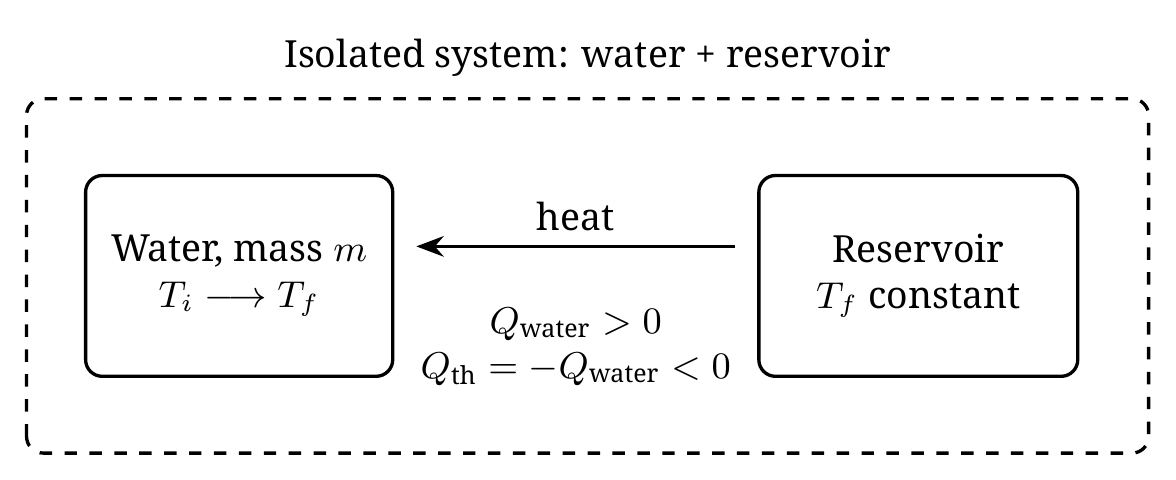
Question 1. The diagram shows the water initially at TiT_i, the reservoir at TfT_f and a heat-flow arrow from the reservoir to the water. A boundary encloses the isolated combined system S+surroundingsS+\text{surroundings}. The water reaches TfT_f without receiving work, so the first law gives

Qwater=ΔUwater=mc(Tf−Ti)>0.Q_{\mathrm{water}}=\Delta U_{\mathrm{water}}=mc(T_f-T_i)>0.

The combined water—reservoir system is isolated: its total energy is conserved,

ΔUwater+ΔUth=0.\Delta U_{\mathrm{water}}+\Delta U_{\mathrm{th}}=0.

Since neither body exchanges work,

Qwater+Qth=0,Qth=−Qwater=−mc(Tf−Ti)<0.Q_{\mathrm{water}}+Q_{\mathrm{th}}=0,\qquad Q_{\mathrm{th}}=-Q_{\mathrm{water}}=-mc(T_f-T_i)<0.

The heat received by the reservoir is negative: it transfers energy to the water.

Question 2. Along a reversible path from TiT_i to TfT_f, the water receives δQrev=mc dT\delta Q_{\mathrm{rev}}=mc\,\mathrm dT. Its entropy change is

ΔSwater=mc∫TiTfdTT=mc[ln⁡T]TiTf=mcln⁡TfTi>0.\Delta S_{\mathrm{water}}=mc\int_{T_i}^{T_f}\frac{\mathrm dT}{T} =mc[\ln T]_{T_i}^{T_f}=mc\ln\frac{T_f}{T_i}>0.

The reservoir remains at TfT_f, hence

ΔSth=QthTf=−mcTf−TiTf<0.\Delta S_{\mathrm{th}}=\frac{Q_{\mathrm{th}}}{T_f} =-mc\frac{T_f-T_i}{T_f}<0.

Since the combined system is isolated, it exchanges no entropy with the rest of the universe. Its entire entropy change is therefore produced internally:

ΔStot(1)=ΔSwater+ΔSth=mc[ln⁡TfTi−Tf−TiTf]>0.\Delta S_{\mathrm{tot}}^{(1)} =\Delta S_{\mathrm{water}}+\Delta S_{\mathrm{th}} =mc\left[\ln\frac{T_f}{T_i}-\frac{T_f-T_i}{T_f}\right]>0.

Indeed, 1/T>1/Tf1/T>1/T_f for Ti≤T<TfT_i\leq T<T_f, so ∫TiTfdT/T>(Tf−Ti)/Tf\int_{T_i}^{T_f}\mathrm dT/T>(T_f-T_i)/T_f. Heat transfer between bodies at different temperatures is irreversible.

Question 3. Set h=(Tf−Ti)/2h=(T_f-T_i)/2, so that Tm−Ti=Tf−Tm=hT_m-T_i=T_f-T_m=h. The water receives mchmc h at each step. Isolation of the combined system gives, for the reservoirs,

Qth,1=−mch,Qth,2=−mch,Q_{\mathrm{th},1}=-mc h,\qquad Q_{\mathrm{th},2}=-mc h,

and therefore

ΔSth,1=−mchTm,ΔSth,2=−mchTf.\Delta S_{\mathrm{th},1}=-\frac{mc h}{T_m},\qquad \Delta S_{\mathrm{th},2}=-\frac{mc h}{T_f}.

For the water, add the changes over the two steps:

ΔSwater=mcln⁡TmTi+mcln⁡TfTm=mc[(ln⁡Tm−ln⁡Ti)+(ln⁡Tf−ln⁡Tm)]=mcln⁡TfTi.\begin{aligned} \Delta S_{\mathrm{water}} &=mc\ln\frac{T_m}{T_i}+mc\ln\frac{T_f}{T_m}\\ &=mc\bigl[(\ln T_m-\ln T_i)+(\ln T_f-\ln T_m)\bigr]\\ &=mc\ln\frac{T_f}{T_i}. \end{aligned}

The intermediate terms cancel. The water's entropy change is exactly the same as with one reservoir: entropy is a state function, and the water's initial and final states are identical in both experiments. Only the path changes. For the isolated combined system,

ΔStot(2)=mc[ln⁡TfTi−h(1Tm+1Tf)].\Delta S_{\mathrm{tot}}^{(2)} =mc\left[\ln\frac{T_f}{T_i}-h\left(\frac1{T_m}+\frac1{T_f}\right)\right].

The difference between the two balances is

ΔStot(1)−ΔStot(2)=mch(1Tm−1Tf)>0.\Delta S_{\mathrm{tot}}^{(1)}-\Delta S_{\mathrm{tot}}^{(2)} =mc h\left(\frac1{T_m}-\frac1{T_f}\right)>0.

Each contact still produces entropy, but the intermediate step reduces the total entropy produced.

Question 4. Set T0=TiT_0=T_i and TN=TfT_N=T_f. At step kk, the water goes from Tk−1T_{k-1} to TkT_k and receives mchmc h. The corresponding reservoir remains at TkT_k and receives

Qth,k=−mch,ΔSth,k=−mchTk.Q_{\mathrm{th},k}=-mc h,\qquad \Delta S_{\mathrm{th},k}=-\frac{mc h}{T_k}.

For the water, the calculation telescopes again:

ΔSwater=mc∑k=1Nln⁡TkTk−1=mc[ln⁡T1T0+ln⁡T2T1+⋯+ln⁡TNTN−1]=mcln⁡(T1T0T2T1⋯TNTN−1)=mcln⁡TNT0=mcln⁡TfTi.\begin{aligned} \Delta S_{\mathrm{water}} &=mc\sum_{k=1}^{N}\ln\frac{T_k}{T_{k-1}}\\ &=mc\left[\ln\frac{T_1}{T_0}+\ln\frac{T_2}{T_1} +\cdots+\ln\frac{T_N}{T_{N-1}}\right]\\ &=mc\ln\left(\frac{T_1}{T_0}\frac{T_2}{T_1} \cdots\frac{T_N}{T_{N-1}}\right)\\ &=mc\ln\frac{T_N}{T_0} =mc\ln\frac{T_f}{T_i}. \end{aligned}

Each intermediate temperature appears once in a numerator and once in a denominator. Increasing the number of reservoirs still does not change the water's entropy change between the same initial and final states. However, the entropy lost by the reservoirs depends on NN:

ΔSth(N)=−mc h∑k=1N1Tk,ΔStot(N)=mc[ln⁡TfTi−h∑k=1N1Tk].\Delta S_{\mathrm{th}}^{(N)}=-mc\,h\sum_{k=1}^{N}\frac1{T_k},\qquad \Delta S_{\mathrm{tot}}^{(N)} =mc\left[\ln\frac{T_f}{T_i}-h\sum_{k=1}^{N}\frac1{T_k}\right].

As N→∞N\to\infty, h→0h\to0 and the Riemann sum tends to

h∑k=1N1Tk⟶∫TiTfdTT=ln⁡TfTi.h\sum_{k=1}^{N}\frac1{T_k} \longrightarrow\int_{T_i}^{T_f}\frac{\mathrm dT}{T} =\ln\frac{T_f}{T_i}.

Thus, the entropy produced in the isolated combined system tends to

lim⁡N→∞ΔStot(N)=mc[ln⁡TfTi−ln⁡TfTi]=0.\lim_{N\to\infty}\Delta S_{\mathrm{tot}}^{(N)} =mc\left[\ln\frac{T_f}{T_i}-\ln\frac{T_f}{T_i}\right]=0.

The water always gains the same entropy, while in the limit the reservoirs lose exactly that amount. Reversible heating is the ideal limit of contacts made arbitrarily slowly with an infinitesimal temperature difference.