Solved thermodynamics exercise
Carnot cycle: energy and entropy along each branch
Exercise 30 · Lesson 6 — The Second Law of Thermodynamics
- Carnot cycle
- ideal gas
- entropy balance
- efficiency
- entropy diagram
Statement
moles of ideal gas with constant heat-capacity ratio undergo the reversible cycle : adiabatic compression from to , isothermal expansion at from to with , adiabatic expansion , then isothermal compression at .
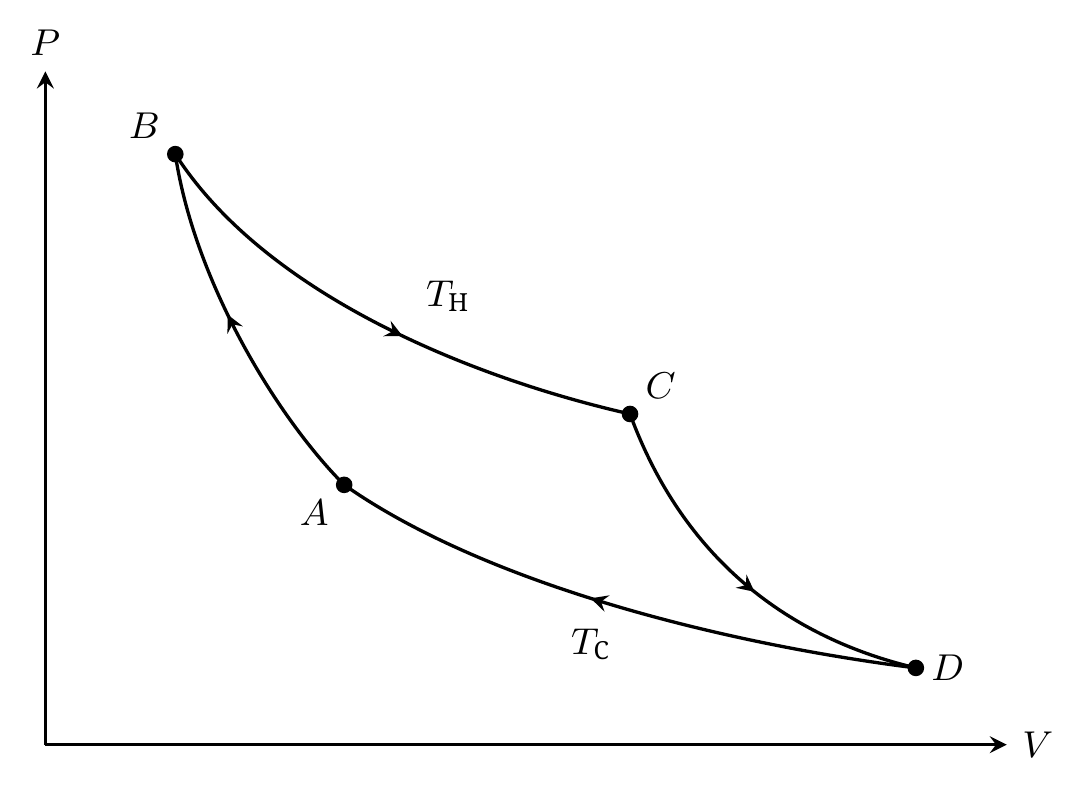
- Identify the isotherms and adiabats on the diagram, then determine and in terms of and .
- Calculate the heat received and the gas's entropy change along each branch. Draw the cycle in the diagram.
- Calculate the work received over a cycle, the efficiency and the entropy changes of both reservoirs. What entropy balance results?
- An irreversible engine receives the same heat from the hot reservoir at and rejects heat to the same cold reservoir at . Express its efficiency in terms of , the entropy produced per cycle in the combined engine and reservoirs.
- Numerical application: , , , and . The irreversible engine in the previous question produces per cycle. Calculate the heat received , the Carnot efficiency, the efficiency reduction caused by this entropy production (in percentage points), and the irreversible engine's efficiency.
Hint
Detailed solution
Raising to the power and setting gives . Similarly, along , Thus : the isotherms have the same volume ratio, traversed in opposite directions. Along an ideal-gas isotherm, , so . For the expansion at the hot temperature, For the compression at the cold temperature, : In the diagram, entropy is constant along and : these branches are vertical. Isotherms and are horizontal. Taking as the relative origin, the coordinates are This gives a clockwise rectangle of width and height . The work delivered is and the heat received from the hot reservoir is . The efficiency is therefore Each reservoir receives the opposite of the heat it supplies to the gas: The gas returns to its initial state, so . The three changes sum to zero: no entropy is produced. Work delivered to the surroundings carries no entropy. Multiplying by and isolating gives The first law gives . The recovered work is , hence Since and , positive entropy production reduces the efficiency. The reversible engine's efficiency is Question 4 gives the difference between the two efficiencies: The numerator is an energy, so the ratio is dimensionless. The reduction is percentage points. Thus, The efficiency falls from to ; a reduction of points is not a relative reduction of .